JD Scholten has traveled to all 375 communities in Iowa’s 4th Congressional District in the past two years, working to earn your vote. In my 60-plus years of living in Iowa I have not encountered a candidate for any office who matches Scholten’s effort. Our country has big challenges like health care affordability/accessibility, a livable rural wage, the increasing power of multinational agriculture corporations that allows them to bully farmers and battling a dangerous virus. Scholten has the energy and infectious can-do attitude to get things done that will help Iowans overcome these challenges and move forward.
It is rare to find a politician who stops telling us stuff long enough to hear what we have to say. Scholten has been listening to Iowans as he travels the state hearing what issues are important to us. He knows the problems we face and will fight for us. He won’t let us be left behind, which is exactly what has happened to many of us in small town Iowa.
It’s time to turn to leaders like Scholten who will put working people first. Give JD the chance to work for you by casting your vote for him this election.
Though a few months remain in 2020, it’s safe to say that this will be a year we won’t soon forget. Problems that are often ignored have been placed directly under the spotlight, and Iowa has not been immune to the nationwide reckoning.
There are numerous issues plaguing rural Iowa. We are losing jobs, businesses are closing for good and many Iowans are losing their farms and their livelihoods. The lasting impact of COVID-19 on small towns that were already struggling will be catastrophic if we do not take immediate action.
Many of our issues are the result of leadership failures by our elected officials. For far too long, this district has not had the representation in Congress that we deserve. Iowa’s 4th District, along with much of the rest of the nation, celebrated Steve King’s defeat in the Republican primary. While his name may not be on the ballot this November, make no mistake: His dangerous ideals linger. The extremist agenda King pushed for 18 years hasn’t left our district. It simply found better branding in the form of state Sen. Randy Feenstra.
Feenstra has campaigned that he has and will continue to deliver for Iowa’s 4th District. What has he delivered during his tenure in the Iowa Senate? He’s delivered a short-sighted policy to remove health care access to thousands of women in rural Iowa, which led to an increase in abortions for the first time in a decade. That same policy resulted in a 74 percent increase in sexually transmitted infections in northwest Iowa communities.
He’s committed to bigotry against the LGBTQ+ community by introducing a bill to remove their right to marry every year he’s been in the legislature. He’s gutted public school funding, while advocating to increase taxpayer funding to private schools. He’s given unwavering support to his party over what’s in the best interest of rural communities by supporting a disastrous trade deal which led to 140% increase in bankruptcies for Iowa farmers. Feenstra has certainly delivered, but not for the hardworking Iowans who are the foundation of what makes our state special.
J.D. Scholten knows what makes rural Iowa great, but also recognizes where we must improve. He’s willing to reject his own party if it means doing what’s best for his district, and his selfless leadership and integrity is what we need during these times of uncertainty.
Scholten is dedicated to reforming the agricultural economy that forms the backbone of rural Iowa to benefit hardworking Iowans. He’s an outspoken critic of multinational conglomerates that wield far too much influence over price and production. Scholten will institute better antitrust laws to protect family farms and consumers, and he understands that blindly cutting taxes for the wealthy doesn’t create jobs in northwest Iowa. His tax reform plan would hold corporations accountable by enacting legislation to make Amazon, GM, and others pay their fair share. This reform will generate sufficient revenue to fund education and public safety initiatives without placing an additional burden on the middle class.
Underfunded public schools weaken our communities. If we continue ripping funds from public schools, we’ll continue to see increased rates of poverty, crime, and civil injustice. Scholten will ensure that every student has access to quality education beginning in preschool regardless of family income. He knows the uphill battle our educators face, and he will work to give them the resources they need to give our students a genuine chance at success.
This pandemic has made it clear that a health care system that only provides protection for some is a danger to all. Scholten is the only candidate committed to providing all Iowans access to quality and affordable healthcare that they need to survive. Rural hospitals are closing at an alarming rate. Scholten will empower rural hospitals by guaranteeing desperately needed funding to provide critical care to all Iowans, no matter where they live. This means ensuring our veterans get the mental health services they deserve, protecting women’s reproductive rights and providing in-school counseling to our students.
Voters in Iowa’s 4th District, we have an incredibly important decision to make this November. Party affiliations aside, I ask you to please examine each candidate on their own merit.
Feenstra’s platform perpetuates the same polices that have let rural Iowa lose jobs and have forced talented individuals to flee in search of a livable wage. It means continuing absentee leadership that has allowed household income for middle America to remain stagnant while the income inequality gap is the largest it’s been since the Great Depression. Feenstra is another politician following in King’s footsteps who doesn’t have the courage to debate his opponent and answer for his failed record.
Scholten will give this district a representative committed to improving quality of life in rural Iowa. A candidate who will hear from you and fight for your family. A man who will work with party leaders on both sides to enact real policy changes. A leader whose moral compass is rooted in his faith rather than the agenda of lobbyists telling him how to vote.
2020 has shown that at every level of government, from small town Iowa to Washington, D.C., we need competent leaders who are dedicated to the promises they made on the campaign trail. Lifting fellow Iowans out of poverty, ensuring schools have the resources they need to give every student a chance, and guaranteeing equality for all Americans are not partisan issues.
Failing schools, public health crises and families suffering across our state are the result of inaction by leaders, but the burden also falls back on us citizens to hold them accountable. We must elect leaders who will act in the interest of our communities. At a minimum, register and go vote, but in the words of the late Congressman John Lewis, “I urge you to answer the highest calling of your heart and stand up for what you truly believe … now it is your turn to let freedom ring.”
Keegan Jones is a 2013 graduate of Fort Dodge Senior High and currently works as a financial analyst and consultant.
2020 has been all kinds of isolating. COVID-19 has forced us to physically distance ourselves from the people and activities we love. The upcoming election has exacerbated divisions among us. The August derecho that hit Iowa caused us to live off the grid for days and weeks (with many individuals who have yet to recover).
During this time, it’s easy to feel alone and unseen. Something that has given me hope has been following and supporting the congressional campaign of J.D. Scholten.
Again and again, I have seen Scholten show up for this district. Whether it’s grabbing a saw and hopping in the car to help our neighbors clear tree limbs the week after the derecho, or packing parking lots for socially distanced rallies in all 374 (!) towns in Iowa’s 4th district, Scholten shows up.
He even drives his own RV (Sioux City Sue) and sleeps at campsites to meet Iowans where they are. During his Ames parking lot rally, we got to talking, and he mentioned he liked my pin, a small, Iowa-shaped flag pin I had gotten for free at an Iowa Cubs game. I told him he could have it, and he excitedly took it, assuring me he’d be wearing it for his upcoming debate. It’s a small thing, and it has nothing to do with policy or party, but it shows me he will always proudly put IA-04 first once he is in Washington.
While his opponent repeatedly declines debate invitations, Scholten never turns down an opportunity to speak to the people of this district, and having visited nearly every town in it, he knows what matters to us and what we need to make it through these difficult times.
It shows he’s here for us, not big-dollar donors and Washington elites. These days, it’s easy to allow ourselves to remain isolated and divided, but I urge you to look to Scholten for inspiration on how to show up for one another and as an indication of how he’ll show up for us when we get him to Washington.
Abigail Boyd is a third-year graduate student in food science and human nutrition.
The conventional wisdom about the congressional race in Iowa’s fourth district is that Republican Randy Feenstra is going to win, not because he’s Randy Feenstra, but because he’s a Republican. That conventional wisdom about IA-04 was nearly proved wrong in 2018, when Democrat J.D. Scholten lost to Representative Steve King by a little more than three percentage points. The near-miss helped the Republican congressional leadership decide to defenestrate King from congressional committees because he was a little too obvious about being a white supremacist. Four conservative candidates went after him in the primary, and Feenstra won.
Is IA-04 still a rural red district where Democratic ambitions go to die, or is Scholten going to finish the job he started two years ago? Without King on the ballot, will he still attract 25,000 Republican crossover votes? We will not know the answer until at least election night, or later. But Scholten has a lot going for him.
Polling: Scholten’s campaign is obviously having an impact. A mid-September Ann Selzer poll showed Scholten within 5 points of Feenstra (658 likely voters surveyed, margin of error plus or minus 3.5 percent). Scholten has an internal poll showing him within 2 percent (500 voters surveyed, margin of error 3.94 percent).
Recent internal Iowa Democratic Party polling in Trump-supporting legislative districts shows that the president has slipped, and some races are very competitive. The fourth district is an R+11 electorate, based on the 2016 presidential results, but high 2018 Democratic turnout is a hopeful sign for Scholten.
Organization: Scholten has a nimble organization, combining experienced staff with an eclectic group of interns and volunteers of all ages and a wide variety of skills. In the new normal of coronavirus, staff meetings are online, and people from all over the country are donating their time and knowledge to creative organizing. The campaign has adopted digital organizing tools used in the Warren campaign and others, and is creating some of its own. There is shared camaraderie, a newsletter for volunteers, regular meetups to connect newcomers with colleagues, and constant training in new tech tools as volunteers come into the campaign. They are working hard and having fun.
Grassroots outreach: Scholten’s motto is “You can’t fake showing up.” He showed up in all 374 towns in the 39 counties of this geographically vast district, finishing in Nashua, in Chickasaw County, on October 6.
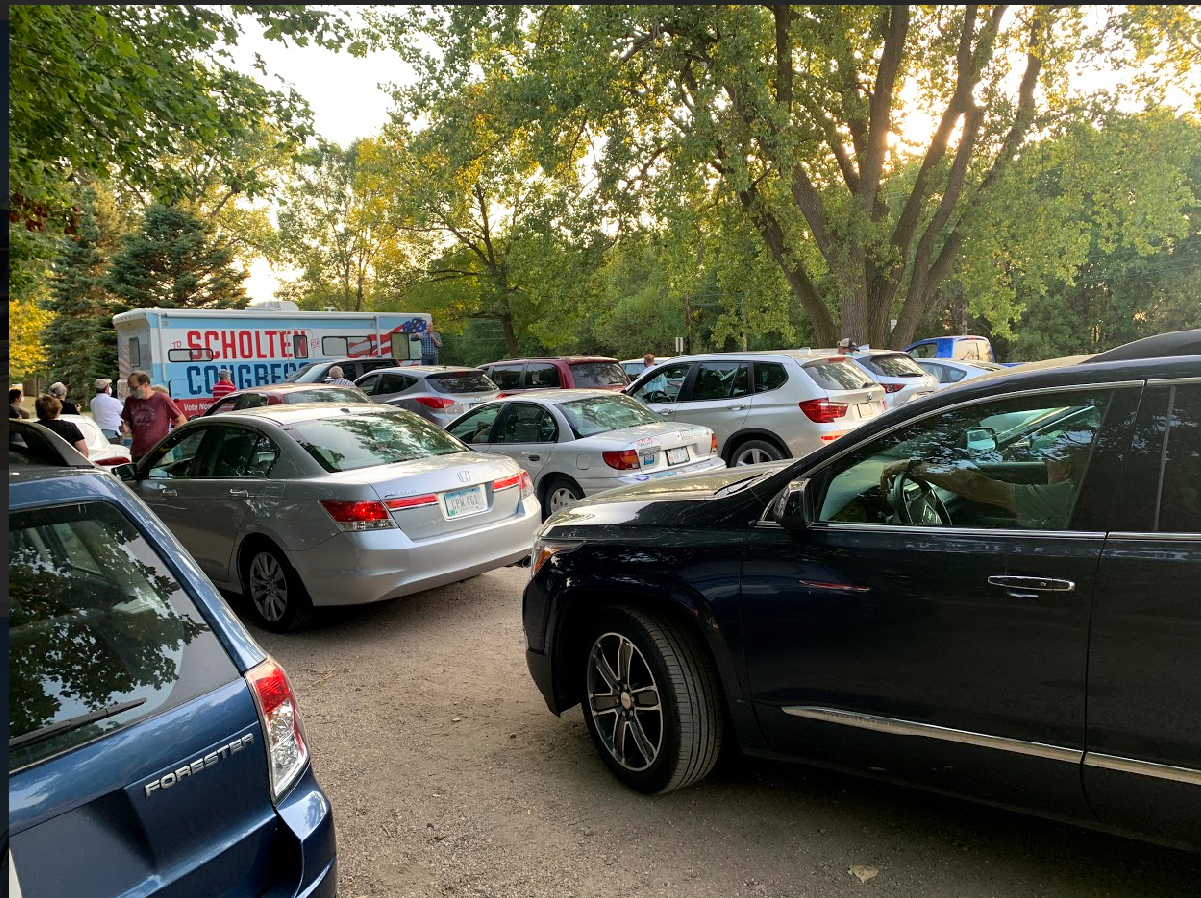
In larger towns, his rallies were arranged like old-fashioned drive-in movies. Tune your car radio to the right frequency and you can hear him speak, standing in the bed of a pickup. In between rallies, he stopped at little towns that no one cares about, other than the people who live there, and listened to them describe their needs and their struggles. Through social media, or because they saw his rickety Winnebago, “Sioux City Sue,” roll into town, people would find out that he was there.
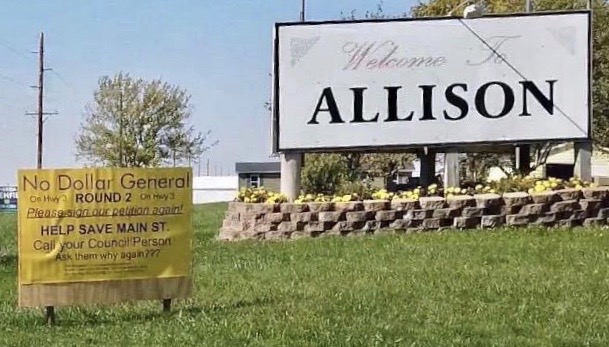
In hundreds of conversations, people shared their worries about the local grocery store being driven out of business by Dollar General, the price of crops being driven below the cost of production by government policies, the stifling impact of agricultural monopolies, their anxiety about the impacts of the pandemic, and their isolation on the wrong side of the digital divide.
If J.D. Scholten goes to Washington, he will carry with him thousands of stories told by rural people struggling to keep their heads above water. His audiences hear some of those stories in his speeches, and heads nod in recognition of hard luck stories about the donation containers in gas stations trying to raise money for yet another person with ruinous medical expenses, or the dairy farmer being driven out of business as processing consolidates and competition disappears.
The down-ballot races: Democrats have managed to field candidates in all but four Iowa House districts, even in some of the reddest ones. Each of these campaigns means more local voter contact, volunteers, and potential turnout.
The opposition: Candidate quality is not determinative in our polarized electorate, but it helps, or hurts. Randy Feenstra is a garden-variety Republican who voted the party line in the Iowa legislature no matter how extreme it became. He relies on a standard litany of Republican wedge social issues to attract conservative voters, and attracts support from Koch-funded groups like Americans for Prosperity with tax cuts and promises of trickle-down prosperity. His comments in live settings sound like repetitive memorized talking points. In June, Vox noted that “Feenstra’s policy platform isn’t significantly different from King’s: Much like Trump, he’s anti-abortion and supports hardline immigration policies including building a border wall.”
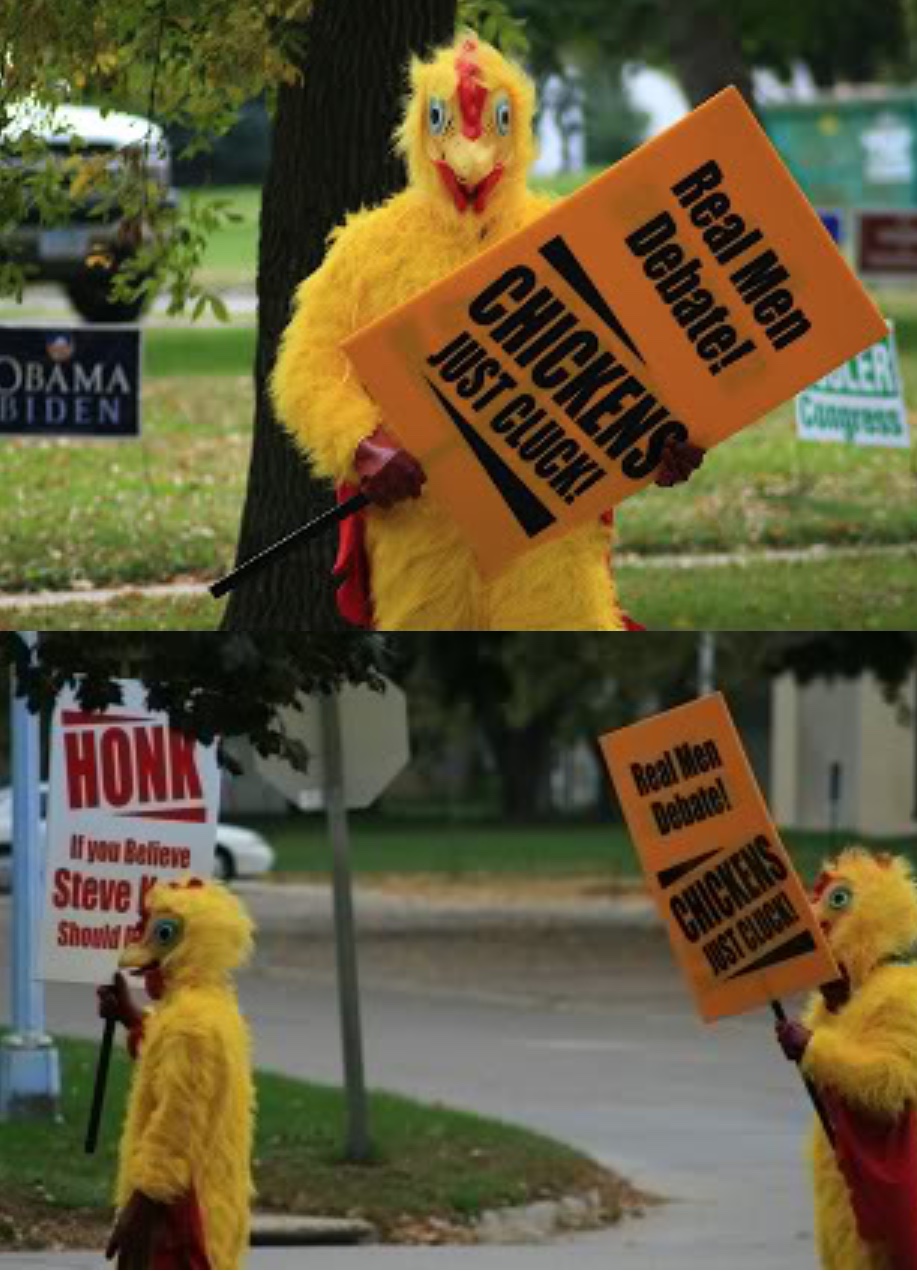
Steve King had people in chicken suits follow him around for his refusal to debate, but Feenstra avoids such humiliations by avoiding voters altogether.Feenstra has no public events, except for appearances with his human shields, Governor Kim Reynolds and Senator Joni Ernst, in front of invited Republican audiences, where he delivers remarks and does not take questions.
While Scholten has put 7,786 miles on Sioux City Sue, going to every town and village in the Fourth District, Feenstra is meeting donors behind closed doors. We are not invited. Feenstra is hoping to run out the clock before the voters have a chance to focus on who he really is, and what he would vote for if he is elected to Congress.
Scholten’s skills apparently are not lost on Feenstra. They have appeared together previously, in small venues, so Feenstra has reason to know he is overmatched. In an August forum in Spencer, Iowa, Scholten talked about the impact of antitrust on agriculture, and Feenstra retreated to conservative bromides about abortion and China.
They have appeared together one time since, in an Iowa Corn Growers event that was not recorded. Feenstra opted to duck a broadcast debate on Iowa Public Television rather than allow voters to see the contrast between them on statewide TV. On October 3, Scholten appeared solo on Iowa Press after Feenstra refused to debate. The program is hosting debates for the other four federal races on the ballot, so Feenstra is the only one of 10 candidates for federal office who didn’t show up, prompting the appearance of a #ChickenFeenstra hashtag.
J.D. Scholten, the candidate: This lanky former baseball pitcher has transformed himself from the earnest and slightly awkward first-time candidate of 2017 into a confident, articulate master of rural and agricultural policy. He knows what people need, he understands why they need it, and he knows what he wants to do to help.
I got to know J.D. early in his 2018 campaign, and I am in awe of the candidate he has become. In some ways, he has not changed: he is the kindest and most open-minded person I have met in politics, and he is really bright. He reminds me of Tom Harkin, one of his political heroes–a visionary who left a legacy of service to Iowans, and to the “least of these” in the world beyond Iowa.
J.D. was beloved by the young organizers who came to Iowa for the presidential campaign. They would chant his name whenever Sioux City Sue rolled in with J.D at the wheel. Some of the presidential hopefuls rode along with him last year, and learned about the needs of rural areas. Some are still trying to help him.
Win or lose, his campaign will have an impact on Congress. But the Democratic Party institutions like the Democratic Congressional Campaign Committee (which ignored him, then embraced him after 2018, then turned their backs on him again after King lost his primary) have had no impact on his campaign. His funding comes from small contributions made by people who just want government to work for them, not for the powerful interests who are raining cash on Feenstra.
J.D. has listened intently to people in the fourth district, and has become their champion. He is motivated by his commitment to his dying grandmother, Fern, to save their family farm, and wants to help all the farm families like theirs. A devout person, he is motivated by compassion and a sense of responsibility for others. He wants to end the cruel distribution of access to health care through GoFundMe, or donation boxes on gas station counters, to people who are left out of the current system. He wants to end monopolies, especially in agriculture and health care, and end the disparities in this country between the powerful few and the rest of us struggling to get by in a pandemic and a recession. He has a vision of farmers in IA-04 leading the fight against climate change and being rewarded for their efforts, instead of being driven out of business by monopolists.
You can’t fake showing up. If we send J.D. Scholten to Congress, he will keep showing up for us.
2020 has been all kinds of isolating. COVID-19 has forced us to physically distance ourselves from the people and activities we love. The upcoming election has exacerbated divisions among us. The August derecho that hit Iowa caused us to live off the grid for days and weeks, with many individuals who have yet to recover. During this time, it’s easy to feel alone and unseen. Something that has given me hope has been following and supporting the congressional campaign of J.D. Scholten.
Again and again, I have seen J.D. show up for this district. Whether it’s grabbing a saw and hopping in the car to help our neighbors clear tree limbs the week after the derecho or packing parking lots for socially distanced rallies in all 374 (!) towns in Iowa’s Fourth district, J.D. shows up. He even drives his own RV (Sioux City Sue) and sleeps in campsites to meet Iowans where they are. During his Ames parking lot rally, we got to talking and he mentioned he liked my pin, a small Iowa-shaped flag pin I had gotten for free at an Iowa Cubs game. I told him he could have it, and he excitedly took it, assuring me he’d be wearing it for his upcoming debate. It’s a small thing, and it has nothing to do with policy or party, but it shows me he will always proudly put IA-04 first once he is in Washington.
While his opponent repeatedly declines debate invitations, Scholten never turns down an opportunity to speak to the people of this district, and having visited nearly every town in it, he knows what matters to us and what we need to make it through these difficult times. It shows he’s here for us, not big dollar donors and Washington elites. These days it’s easy to allow ourselves to remain isolated and divided, but I urge you to look to J.D. Scholten for inspiration on how to show up for one another and as an indication of how he’ll show up for us when we get him to Washington.
For years, Republican candidates for the U.S. House of Representatives have coasted to electoral wins in the Fourth District without effort — little campaigning or defense of their legislative records. They refused to debate opponents, knowing that a natural lead in voter registrations would carry them into office.
What did Fourth District residents get for their party loyalty? Not much. Instead, the knowledge they had a so-called “safe seat” let folks like Steve King pursue their own, often outlandish, agendas. Instead of working to bring benefits and business to the rural counties he represented, King sought TV time and national fame by railing against immigrants and conducting private wars on Democrats.
Randy Feenstra promises little change. He, too, has refused to debate his opponent, J.D. Scholten, and is taking it easy, trying to avoid controversy. Feenstra thinks it’s in the bag, and that what he does or says makes little difference — just like King.
Not so with Scholten, who has worn out the tires on his RV, visiting every town in the district and listening to voters — even the many who undoubtedly disagree with him, not necessarily because he’s wrong but because he’s in a different party. Say what you will, but Scholten isn’t lazy and he takes nothing for granted. He genuinely cares for the district, its citizens and its small towns. You may not always like his positions, but you’ll know they’re what he believes is best for his constituents, not just blind adherence to party diktat.
Stop the cycle of neglect. Elect someone truly beholden to the Fourth District. Vote for J.D. Scholten.
Last time, it was the Don’t Forget About Us Tour. This time, it’s the Every Town Tour. Either way, congressional candidate J.D. Scholten of Sioux City says he’s still prioritizing conversations and building relationships during his second run at a seat in the U.S. House. Scholten’s tour of 374 towns in Iowa’s 4th District was drawing to a close as he held a parking lot rally outside the Spirit Lake Expo Center the night of Sept. 30.
Scholten’s first congressional race pitted him against then-incumbent U.S. Rep. Steve King during the 2018 election cycle. Though he lost to King, his campaign earned 25,000 more votes than the total number of registered Democrats in the district. Scholten will take on state Sen. Randy Feenstra of Hull in the November general election — Feenstra beat King in the Republican Primary this past June.
Scholten said he takes pride in visiting rural communities and hearing the public’s stories as well as their concerns.
“This district is so different in different places, so we’ve got to make sure we have someone who shows up and is willing to listen and willing fight for all the people of this district,” Scholten said.
And he feels his renewed campaign for the House has continued building on the rapport he struck with voters during the previous election cycle.
“When we do this 374 town tour, it’s not like we’re only talking to Democrats,” Scholten said. “We’re talking to people all over the political spectrum. Especially when it comes to agriculture and us being the second most agriculture-producing district in America — I’ve talked with farmers who will never vote for me and farmers who will always vote for me and everybody in between — and when I talk about antitrust and agriculture right now, all of them, regardless of where they are politically, are on board with what we have to say.”
Scholten told the 60 or so vehicles gathered in Spirit Lake local agriculture is one of the areas which most highlights the shortcomings of the current economy when contrasted with corporate farming companies. He said the situation has been exacerbated by the COVID-19 pandemic.
“We have consumers paying the most we ever have for meat,” Scholten said from the bed of a red pickup truck. “We have workers in Sioux City at the processing plant getting the same wage as when my family moved from Nevada (Iowa) to Sioux City in 1984. Meanwhile, we have farmers getting squeezed, and so our campaign is going out there and connecting with people and building this coalition of consumers, workers and farmers, and we’re working on just leveling the playing field.”
Scholten also sees the need for campaign finance reform. His campaign has touted its refusal to accept funding from political action committees, saying politicians often accommodate the requests of the special interest groups which helped finance their political careers.
“It’s really frustrating when you see so many people pushing for something, but it’s not happening out in D.C., and it’s because of campaign finances,” Scholten said. “We see so many members of Congress who are taking money from these monopolies, from these groups, from these people who are sucking the wealth out of rural areas, and these career politicians are selling us out.”
The former baseball player held up one of his campaign’s trading cards for the Spirit Lake audience, and he pointed to his primary campaign promise — Iowans over political party.
“We invite everyone to the table,” Scholten said. “It doesn’t matter if you’re Democrat, Independent, Republican or have never voted before. We invite you here. We only have one rule, and it’s that we respect each other, because at the end of the day, we’re all Iowans.”
Democratic candidate for Iowa’s 4th Congressional District J.D. Scholten returned once more to the city of Spencer as he continues to meet voters on the campaign trail ahead of the upcoming general election. Scholten addressed voters with a drive-in rally in the Southpark Mall parking lot on Saturday evening, being broadcast into the vehicles parked around the Democratic candidate. Scholten outlined his five campaign promises: Iowans over political party, showing up for the 4th District, fix health care, fight for an economy that works for everyone and secure our democracy from special interests; which were printed on the back of baseball cards given to supporters.
Democratic candidate for Iowa’s 4th Congressional District J.D. Scholten returned to Spencer on Saturday, parking Sioux City Sue outside Southpark Mall for a drive-in rally. Scholten spoke to the audience through their car radios and took questions virtually while also gauging answers with honks through the event.
“When it comes to health care, almost every stop where we’ve had a dialogue, every town hall, farm forum, almost everything reverts back to health care is the No. 1 issue,” Scholten said. “… It’s overwhelming how many health care stories there are just from this district alone. I want talk about two, one is a mentor of mine. He’s a successful attorney, I was working as a paralegal, he took me under his wing. Last fall he was diagnosed with cancer. After four months of going through chemo and fighting, what happened was his insurance company called him and said ‘your doctor is no longer in your network.’ At a time when he’s fighting for his life he has to switch doctors and it’s inhumane. We need a better system. … Last year in Hardin County a woman told us she needs an inhaler and her doctor prescribes a 30-day prescription. After 30 days she needs a new one so it was costing her $244 a month. She told her doctor, ‘doc I can’t afford that anymore, so the doctor goes ‘well here’s one that’s cheaper but it’s less puffs.’ After a few more months she’s like again, ‘this is too expensive.’ Finally the doctor told her, ‘just go up to Canada.’ That’s where we’re at. We are the wealthiest nation in the world and we have a system where we tell people ‘go up to Canada to get your prescription drugs’ and that’s wrong.
He continued, “I want to fight for universal health care. I want to continue to fight, what the next logical step seems to be is a robust public option. And I’m for that but we need to continue on until we have absolute universal health care. And we need to make sure we protect preexisting conditions, we need to make sure Medicare and Social Security things that are being threatened right now, not only do we protect them but we expand them. We need to make sure prescription drugs are available and you don’t have to go bankrupt just to stay healthy. All these things add up.”
Fielding questions from the audience, Scholten was asked if he expected a debate with his competition for the 4th District seat, state Sen. Randy Feenstra, R-Hull. Scholten said his campaign has said yes to “any place, any time.”
“We have said yes to every single debate,” Scholten said. “There was a forum here early on, with me, Senator Feenstra and Sen. Joni Ernst, but a forum is not a debate. We’ve said yes to every single debate where we can actually talk about issues and question each other on issues, and have that dialogue back and forth. The problem is they have said no officially to three debates including KTIV’s. … They also have not responded to the majority of the ones being offered.
He added, “It is way different than last cycle in the sense that last cycle we had a 16-year incumbent who didn’t think he was much in a challenge, but we showed him wrong. This is a race that’s neck and neck. The polls are showing that. … This is, we absolutely need to have a debate, this is democracy.”
During the question and answer session Scholten also touched on criminal justice reform, to which the candidate said subjects like mandatory minimums and cash bail are things that need to be talked about more.
“The other thing I think we should talk more and more about is private prisons,” Scholten said. “We should not have a prison system that incentivize keeping people in for profits.”
Scholten ended the drive-in rally by telling the audience of his excitement for the 4th District race, which was answered by the blaring sound of honks of support from the more than three dozen vehicles parked around the candidate and his RV, Sioux City Sue.
J.D. Scholten speaks to Cheri Shatto following his event Saturday.
“This race is going to come down to the wire,” Scholten said. “… We are in a special spot and everything, we’re right where we need to be.”
Democratic congressional candidate J.D. Scholten campaigns in Carroll Monday night as part of a swing through west-central Iowa. He spoke to voters in about 30 cars at a “drive-in” campaign event.
J.D. Scholten bounded on to the trailer of a pickup truck parked in front of his rickety RV and Carroll’s Merchants Stadium for a fiery populist speech, one that seemed to jump from an earlier era in Iowa as the congressional candidate made a relentless case for the working people he thinks society is leaving behind.
“We don’t have enough working-class people in Washington, and that’s one of the big reasons I’m running,” Scholten said as day turned to night under colorful fall skies.
Scholten, a Sioux City Democrat, stopped in Carroll Monday night as part of a major swing through the region. He made five stops in Greene County, hit Coon Rapids and spoke in Denison in recent days. The events are part of a 375-town tour of the 39-county 4th Congressional District.
Scholten said he is campaigning in all counties for a reason.
“So much in DC is just butting heads against the other side,” Scholten said. “I’ll always show up.”
About 30 cars ringed Scholten’s truck and RV — which he’s named Sioux City Sue — in Carroll for a “drive-in” campaign speech, one Scholten broadcast into voters’ vehicle radios.
The No. 1 topic Scholten hears about from voters: health care.
He supports getting to universal coverage with a public option as something of a temporary weigh station. The public option is a government plan that competes with private insurance coverage, giving consumers more choice and, Scholten believes, driving costs down. He’s also making a case for better “dental and mental” health-care coverage.
“If we are the wealthiest nation is the world, then let’s show it by how great our health-care system is,” Scholten said.
Alcohol and drug addiction are becoming more worrisome as people struggle in often-desperate rural economies, he said.
“The haves have gotten a lot richer, and the rest of us have struggled,” Scholten said.
He added, “Most of rural America has not bounced back from 2008, let alone what is happening now.”
Scholten blasted a tax system that allows large companies like Amazon to pay little or no taxes.
“I don’t even know if I know a lobbyist, but I sure know a hell know of a lot of you guys,” he said in Carroll.
Scholten sees the United States as being in a global economic and power showdown with China. It will take the full country, operating with success, to compete, he said.
“It can’t just be Silicon Valley versus China,” Scholten said.
SIOUX CITY — Six weeks from now, the outcome of the Iowa 4th Congressional District contest will be revealed, with Nov. 3 voting determining whether Randy Feenstra will seize the win and continue the Republican Party hold on the seat or if J.D. Scholten pulls off the upset that narrowly eluded him in 2018.
At this point two years ago, campaign donations were flowing in large fashion to Scholten. A lot of people were motivated down the stretch to oust incumbent U.S. Rep. Steve King, R-Kiron, after a flurry of questions about his support for far-right political parties and candidates.
That primary win immediately moved many political prognosticators to predict a solid Feenstra victory in the fall. An Iowa Poll by The Des Moines Register over the weekend put Feenstra’s lead at 5 percentage points, and, for comparison, Scholten’s narrow loss to King was by 3 points.
“A lot of people wrote us off in early summer. We just put our head down,” said Scholten, who is bullish on his chances over the next 42 days.
“We are right where we need to be … Our internal poll showed we are doing even better than what the Des Moines Register poll showed,” he said.
Scholten said he believes he can win because “this district has a lot of independent thinkers.”
There are more independents than Democrats, as voting registration in the 4th District in September shows 203,921 Republicans, 128,750 Democrats and 153,416 no party, making for a big advantage for Feenstra. Feenstra said being a Republican in the 4th District is certainly an advantage, but he isn’t taking that for granted.
“We are trying to motivate the base. We are playing like we are 10 points behind,” he said.
King had never lost a race in his 24-year political career, until Feenstra, a state senator from Hull, won in the five-candidate primary. In a Journal interview on Friday, King said he would not endorse Feenstra, saying it was best not to comment on his campaign.
Said Feenstra, “I would appreciate it if he would endorse me … I guess it is up to him … We just want all the Republicans marching in the same direction.”
Earlier this year, spread of the novel coronavirus resulted in a halt to in-person campaigning, but some of that has resumed in recent weeks. Scholten has been holding “parking lot rallies,” where he stands on a flat-bed truck, his comments are broadcast via radio frequency to people parked at the event, and they can send text messages to pose questions. That’s part of his swing to visit all 374 towns in 39 counties, and, after one Tuesday in Jefferson, Iowa, Scholten said that quest will be done by early October.
Scholten said key issues he’s seeing connect with the pandemic, as people are worried about maintaining health insurance and hearing Republican plans to reduce Medicare and Medicaid programs. He also said farmers are uneasy after seven years of low commodity prices and tariffs that Trump put in place.
Feenstra spoke after touring a biodiesel plant in Wall Lake, Iowa. He said he’s visiting businesses using social distancing precautions and wearing masks. Some of the monthly county Republican Party organizations have resumed meetings in person, while many still only do them via video conferencing.
Feenstra said top issues are boosting agricultural opportunities and the prospects of small businesses, some of which have not reopened since the coronavirus brunt hit. He said it is imperative that pro-life policies are pursued.
“People are looking for somebody who can deliver or be a voice for them,” Feenstra said.
It is currently uncertain whether an opportunity for Iowans to see the two men hash over issues side by side, as of now there are no set debates. Scholten said his approach is “any time, any place,” and that a debate is needed, since people know Feenstra far less than they do King, after his 18 years in office.
For his part, Feenstra said there are some October media debate options, and he may agree to some: “We are looking at other arrangements.”
There won’t be a release of campaign fundraising until mid-October, for a quarterly summary for the months of July through September.
This year, Scholten has led all Iowa 4th candidates in fundraising, such as when he raised $619,849 for the second quarter through the month of June. Feenstra brought in $403,817 over that same time. Combined over the 2020 cycle, Scholten has raised $1.65 million, while Feenstra has had $1.25 million in contributions.
Scholten said his third quarter fundraising number will surpass that of the second quarter, and said people who believe his 2020 funding will pale compared to 2018 are misguided.
A December 2018 fundraising report showed Scholten raised more than $1.5 million from Oct. 19 to Nov. 26, just before and after the election day showdown with King.
Feenstra said Scholten may not nab the top amount of fundraising of the 2018 final stretch, since “the dynamics have changed significantly over the last two years.” As for his fundraising, Feenstra said, “We are looking at a very strong quarter again … We are trying to get as much in-state money as possible.”