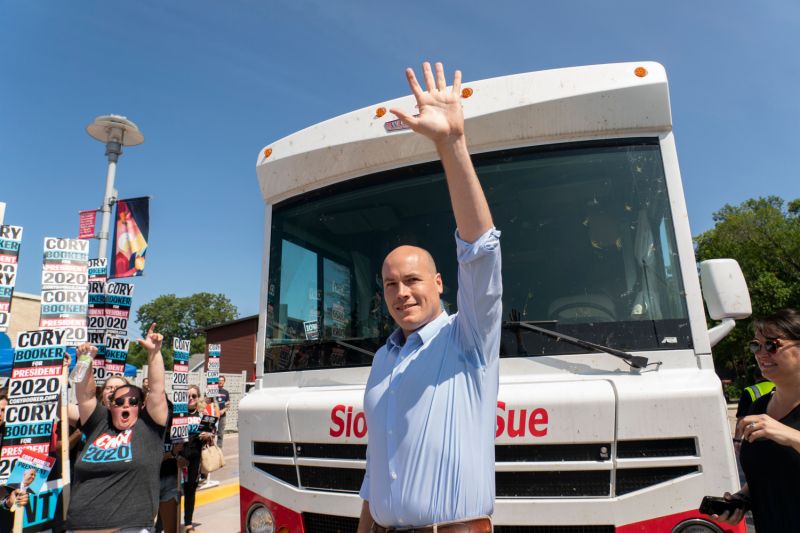
J.D. Scholten didn’t speak much about his professional baseball career Thursday, Aug. 20, in Sioux Center, but his five campaign promises were printed on baseball cards for the audience to keep.
Those campaign promises were the focus of the remarks by the 40-year-old Democratic candidates for Iowa’s 4th District in the U.S. House of Representative.
He spoke from the back of a pickup truck at the Sioux County fairgrounds parking lot while people in about 20 vehicles tuned into his message broadcast on the radio. He held a similar event on Wednesday in Sibley.
Scholten narrowly lost to longtime Republican incumbent Rep. Steve King in 2018. On Nov. 3, however, he will go up against state Sen. Randy Feenstra, who unseated King in the June Republican primaries.
Scholten’s first promise was to put the interest of Iowans over the interest of politics.
Instead of political ideology, he said a message that connects to people has the power to earn votes. That led to his next promise, which was simply that he will show up for people in the 4th District.
At the Sioux Center event, Scholten noted how in the fall, he conducted a “Don’t Forget About Us” tour in which he visited the district’s communities with fewer than 1,000 people.
“We’re willing to show up and we will continue to show up because this job is about service,” Scholten said. “It’s about giving back.”
His next three promises were to fix health care, fight for an economy that works for everybody and secure the country’s democracy.
When talking about health care, Scholten brought up the story of an attorney who mentored him while Scholten worked as a paralegal. The attorney recently was diagnosed with cancer but was told by his insurance company his doctor was no longer within its network.
“When he’s fighting for his life, he has to go find another doctor and that’s just wrong,” Scholten said.
He also said health care also was the No. 1 issue he spoke to people during his small-town tour last fall.
In Hardin County, a woman had told Scholten how she could not afford an inhaler prescription which would cost $244 a month. Even when her doctor gave her a cheaper one with fewer doses, she still could not pay for it. Her doctor eventually told her to go to Canada to buy an inhaler.
“If that’s the best we are as a nation, we can do way better,” Scholten said.
When speaking about fighting for an economy that works for everyone, Scholten said career politicians have sold out people such as farmers, teachers and everyday consumers with policies that do not adequately value their work.
In agriculture specifically, he spoke about how concentration of large dairy, pork and cattle companies have hurt small farming operations. He also mentioned how President Donald Trump’s small-refinery exemptions to oil refineries have hurt corn producers.
“They’re picking sides and it’s big oil conglomerates over the American farmer, over our Midwest corn growers,” Scholten said. “One thing we’re pushing for is not only making sure that the renewable fuel standard is met at that 15 billion gallons of ethanol per year in our fuel supply but we’re pushing for a low-carbon fuel standard.”
His final promise about securing democracy focused on how special-interest groups and their lobbyists in Washington, D.C., dictate policy by giving money to lawmakers through political action committees. Unlike those lawmakers, Scholten said his campaign does not accept corporate money or support from the Democratic Congressional Campaign Committee.
“We wanted to run out of Sioux City, Iowa. We wanted to be held accountable by the people of this district, rather than the folks out in D.C.,” Scholten said.
He later took questions from attendees after they texted them to his campaign staff. One question was how Scholten would protect Social Security and Medicare.
Scholten said he supports a policy proposal called “scrap the cap,” which would require people to pay into Social Security past the $137,700 income limit. Regarding Medicare, he supports expanding the program and lowering the age limit so people can access it by age 50.
He also was asked how he would get large companies such as Amazon to set up locations in places such as N’West Iowa. He reframed the issue to instead say he would push for tax cuts to small businesses that already exist in such places.
“What we need to do is give tax breaks to the small businesses, the innovation, to help create local economies,” he said.
“When you spend money at Dollar General, it doesn’t always stay here. It goes to headquarters, it goes to Wall Street. What we need is to strengthen our Main Streets and we need an economy and a tax system that benefits that.”
Congressional candidate JD Scholten, like so many other politicians, has had to adjust his campaign operations during the COVID-19 pandemic. Wednesday, the Democrat spoke to supporters during a “drive-in” campaign stop in Sioux City.
Supporters could pull up to North High School, stay in their cars, and tune to a specific radio frequency to hear Scholten speak just a few feet away. This method allows him to travel to all 39 counties in the 4th Congressional District, and allow voters to safely hear his message. He also acknowledges — during the pandemic — reaching voters can be difficult.
But, he says, it’s not impossible.
“I want to meet with everybody. I want to be accessible. We are open to everybody. Everyday we talk about it doesn’t matter if you’re white, black, or brown. It doesn’t matter if you’re a Democrat, Independent, Republican or never voted before. We’re going to go out there and try and earn your vote.” said J.D. Scholten, 4th District Congressional Candidate
Scholten also took time to answer questions texted to him, and to hand out campaign baseball cards containing his five campaign promises,. They include fixing healthcare, and fighting for an economy that works for everyone. Scholten will face Republican candidate Randy Feenstra in the November general election.
Sioux City’s North High School parking lot hosted a rally in support of the democrat running for the 4th congressional district in Iowa.
J.D. Scholten’s “Every Town Tour” brought local supporters to this socially-distanced event.
Attendees could listen in, from the comfort of their vehicles, by tuning in to 89.9 FM.
The tour will eventually cover 375 towns in Iowa’s 4th district, giving Scholten a chance to meet his supporters.
“We’re trying to get out the best we can. That’s the tough part. I want to meet everybody. I want to be accessible. We are open to every day. Every day we talk about, doesn’t matter if you’re white, black or brown, doesn’t matter if you’re democrat, independent, republican or never voted before. We’re going to try and earn your vote,” Scholten said.
Scholten will be hosting more parking lot rallies in Woodbury, Plymouth, Ida and Cherokee counties this weekend in an effort to connect with as many people as possible.
The Democratic candidate for Iowa’s 4th district congressional seat has a new twist on campaigning during the Covid era. J.D. Scholten has equipped his “Sioux City Sue” RV with special equipment so he can hold parking lot rallies.
“I know a lot of churches have gone this way,” Scholten says. “We’re going to have a site where people can go and drive to and if they just want to stay in their car and tune in on the local frequency that we’ll be broadcasting, they can do that. Otherwise they can come out of their cars and just make sure that they’re socially distant.”
The RV will have speakers, so those who stand outside the R-V will be able to hear, along with those tuned-in and sitting in their vehicles. Scholten is planning to visit all 375 towns in the district before Election Day.
“We are taking extra precautions,” Scholten says. “Wear a mask. We’ll have a lot of hand sanitizers and things like that.”
This is Scholten’s second run in the district. In 2018, he narrowly lost to Republican Congressman Steve King. In 2020, he faces Republican Randy Feenstra, who defeated King in the June 2nd GOP Primary. A recent poll suggests Feenstra has a comfortable lead in the district, which has a significant Republican voter registration edge.
“The last time and again this time, we say all the time that it doesn’t matter if you’re white, black or brown, it doesn’t matter if you’re Democrat, independent Republican or never voted before — we’re going to go out there and earn your vote,” Scholten says, “and that continues to be our strategy.”
On Tuesday evening, Scholten’s holding a parking lot rally at the Plymouth County Fairgrounds in Le Mars. On Wednesday evening, he’ll speak from the Sioux City North High School Parking lot.
Iowa congressional candidate J.D. Scholten told Hill.TV that he doesn’t need help from the Democratic Congressional Campaign Committee (DCCC) to win a long-held GOP seat in Iowa, arguing his message of progressive populism will be enough to secure victory in November.
Scholten is making another run at the House seat for the 4th Congressional District after coming within 4 percentage points of Rep. Steve King (R) during the midterms in a district President Trump won by nearly 30 points in 2016.
Scholten will face Randy Feenstra, who defeated King in June during the GOP primary.
He told Hill.TV he declined help from the DCCC — the House Democrats’ campaign arm — because he felt it would impose limitations on his campaign.
“I want this race to be run out of Sioux City and not DC,” Scholten said. “And ultimately, I’m not running to win their approval. I’m running to win this race.”
When reached for comment, DCCC spokesperson Cole Leiter said: “We have built a big battlefield and every candidate is going to make their own decisions about how to run their race. We wish him well.”
The Cook Political Report lists the seat as “likely Republican.”
Though the Democratic Party has long been unpopular in his district, Scholten said voters involved in regional agricultural businesses have been hurt by a lack of antitrust enforcement. He is hoping to capitalize on what he says is a long-present populist spirit in the district.
“My campaign right now is building this amazing coalition of consumers, of workers and of farmers, all that are being hurt by these monopolies,” Scholten said. “The farmers are being squeezed, both on the input and the market side. The workers are being suppressed. They’re getting the same wages that they did when my family moved to Sioux City in 1984. And you have these consumers that are paying more for meat than they ever have been. And so that money isn’t going to any of them. It’s going to profits and to Wall Street.”
Walk through any family farm, down any empty but once-thriving Main Street, or by any small hospital in Iowa’s 4th Congressional District, and you’ll see countless examples of what corporate greed and corruption are doing to our rural communities here. Much like the rest of rural America, corporations are stripping away wealth, power, and opportunities in this district—leaving shuttered downtowns, abandoned schools, and bankrupt family farmers in their devastating wake.
In food and agriculture, corporations push the little guy off the farm, fail to pay farmers a fair price, and undercut small independent grocers. Middleman meatpackers pay low prices to farmers and demand high prices from grocery stores, and pocket the difference. In health care, the managed-care organizations that have taken over Iowa’s privatized Medicaid system underpay providers like critical-access hospitals and nursing homes, forcing them to cut or outsource services, reduce staff, or consolidate. In business, 91 corporations pay zero dollars in federal income taxes while our small businesses try to get by. Across the board, rural families suffer while corporations pocket the profits.
How did we get here? Part of the answer involves who gets a leg up in our elections, and unsurprisingly, it’s the 1 percent. They can self-fund their candidacies or tap high-powered, wealthy friends for donations. When in office, they reward their wealthy donors and friends with tax loopholes and benefits. These candidates aren’t folks like me.
My parents were high school teachers. Although they weren’t able to pass down a fortune to my sister and me, they did pass down good values of decency, honesty, and the importance of faith and hard work. My candidacy for Congress is all about fighting for folks like them—the truck driver, the farmer, the teacher, the nurse. Folks who are doing everything right, working hard, but still struggle to earn a decent living, pay for school and health insurance, and save for retirement.
The political system isn’t made for outsiders like me to succeed, but I don’t need party leaders or corporations to be on board with my candidacy. That’s why I told the Democratic Congressional Campaign Committee (DCCC), the House Democrats’ campaign arm, to stay out of our race last week. Their ideal candidate can either self-fund their race or sit at home and fundraise all day; follow their strategy; and echo their talking points. That’s not what’s best for Iowans here in the 4th District. It never has been and will never be how I represent our district.
Across the board, rural families suffer while corporations pocket the profits.
I will always speak truth to power, even if those in power are leaders of my own party. My mission first and foremost is to serve the people of Iowa’s 4th Congressional District and address the serious challenges facing rural America that result from the failures of both parties. Accepting corporate PAC money doesn’t address these challenges. Accepting help from outside organizations that don’t understand Iowa doesn’t address these challenges. If I followed this playbook, I would be just another empty suit at the beck and call of corporations and political parties.
My opponent, Randy Feenstra, doesn’t share this sentiment. He built his candidacy during the primary on the fact that he’ll be the best “ally” to President Trump. He ignores the fact that Trump’s policies—from the devastating trade war to abuses of the Renewable Fuel Standard to structures that tell lifelong residents to “get big or get off the farm”—have gutted our local rural economy. It’s far more important for him to be a loyal lackey to the president than to stand up against two-faced lies and outright attacks.
When it comes to corporations, Feenstra doesn’t turn down a dime of their blood money. He’s pocketed over $60,000 from multinational corporations squeezing our farmers out, about $50,000 in direct contributions and tens of thousands more from the independent expenditure PACs from the pharmaceutical industry, and tens of thousands of dollars from the managed-care industry. Corporate donations don’t come for free; candidates must trade political access and favors in exchange for their “generosity.” Feenstra is already selling out Iowans to the highest bidder and if he’s elected to Congress, it won’t stop.
All this boils down to accountability. Elected officials should be accountable to the people they serve, not those who are able to write the biggest check. Randy Feenstra and I are both asking to serve the people of Iowa’s 4th Congressional District, but how can he do so if his allegiance is to corporations and party officials first? I challenge him to be his own man and not a corporate stooge: Drop the corporate donations and unwavering loyalty to your party and put Iowans first.
This op-ed was written by J.D. Scholten and was published in The American Prospect.
Many turned their attention from the Fourth Congressional District after Randy Feenstra beat incumbent Rep. Steve King in the June Republican primary, thinking that the story is written.
Far from it, says Democratic opponent JD Scholten. He makes a strong argument about why you should pay attention:
An internal poll commissioned by Scholten two weeks ago showed the Sioux City paralegal in a “statistical dead heat” with Feenstra, a state senator from Hull. Scholten has more than $1 million in the bank and says fundraising is going well. He has raised more than any Democratic who has run. He is outraising Feenstra, who just accepted $2,500 from Smithfield Foods, a subsidiary of China. Scholten calls him “Corporate Randy.”
Scholten declined to reveal many details from the poll, other than to say that it confirms a Des Moines Register-Mediacom Iowa Poll that shows a generic Democrat trailing a generic Republican by 22 percentage points. But when names are attached, Scholten jumps into a dead heat, he said.
“This is about as good a place as we could hope to be,” said Scholten, who came within three percentage points of King, R-Kiron, in the 2018 midterm election.
That showing prompted a crowded June Republican primary that saw Feenstra easily defeat King. And that led many to write off Scholten’s prospects against a state senator in such a heavily Republican district. The Democratic Congressional Campaign Committee, which said it would jump into this race last winter, now is not quick to return Scholten’s calls. And that’s okay by him.
“What else do I have to prove? The polls suggest that they like me but they don’t like Democrats here,” Scholten said.
Scholten said his message on restoring rural opportunity, decent jobs and improved health care access polls well among independent and disaffected Republican voters.
Recent polling by Rural Organizing, a progressive group, shows that Biden is in a dead heat with Trump among rural and exurban Iowa voters, and that Theresa Greenfield has a two-point lead over Republican Sen. Joni Ernst among this cohort. Scholten says that Biden two weeks ago was behind by 13 points in the Fourth District.
“If Biden gets that down to single digits, it’s game on,” Scholten said, “because we have shown that we punch above our weight. We will outperform the presidential ticket.”
Biden declared last weekend that Iowa is “a critical battleground state.” That’s music to Scholten’s ears.
Trump and Ernst have done nothing but fall in the polls for three years. That’s a lot of weight on Feenstra, who eagerly supported Trump.
Scholten said he is still trying to figure out how to campaign down the stretch in the pandemic era. One idea: drive-in rallies. Scholten bought a radio transmitter so voters can stop in the parking lot and listen to him stump.
“It’s an idea,” he said.
He has a lot of goodwill built up by campaigning so hard last fall in towns under 1,000 population in his heavily used Winnebago, Sioux City Sue, and from his previous campaign against King.
Those who write him off are not his concern. He believes he connects with the populist undertone that King was able to tap, albeit with a racist flair. Scholten polishes the other side of that penny with a stridently progressive campaign centered around economic issues: health care, the power of huge corporations and dark money. He says rural people are tired of watching their grocery stores and hospitals close and seeing their fortunes vanish. The best blue-collar jobs pay $18 per hour. Their frustration is what led to Steve King. Scholten says he is the alternative to another corporate hired man. His campaign has legs that should not be underestimated. When Joe Biden leads in multiple polls of Texas, something is happening that makes all things political possible.
Envie o entrega en persona su formato de solicitud de boleto de ausencia a su auditor del condado local. Puede encontrar las direcciones aquí. Solicitudes de boletos de ausencia necesitan ser recibidos el 30 de Octubre.
Regrese la solicitud el 3 de Noviembre a las 9:00pm CT.
Nota: La solicitud será enviada a usted el 5 de Octubre.
Three times a week, a middle-aged, 6-foot-6 man plays long toss by himself at the Sioux City East High School practice football field, heaving 28 baseballs into a net some 200 feet away. He started with 30 balls, but one got water-logged and the other was lost to, shall we say, control issues. Some days, he moves to the visitors’ bullpen of the baseball field and, again, throws alone, into the net.
The man turned 40 a few months ago and he’s trying to prove something to himself, in the way that turning 40 tends to shift the focus of your competitiveness from others to your own, certain physical decline. The man has challenged himself to get back to throwing a baseball 87 miles an hour. From the ground, not off the mound.
Why 87? Because the man is a big Minnesota Twins fan and he’s honoring their 1987 World Series title. And also because honoring the 1991 championship felt too ambitious.
⚾️ Update: Seeing the MLB draft got me motivated to stretch it out a bit. This is a little over 200 ft out, nothing too strenuous yet. You can barely see a short hop of the net.
We all need a project during the pandemic, and rather than bake bread or brew beer or plant a garden, J.D. Scholten is trying to get his fastball back, reliving a semi-pro pitching career that took him to five countries. But the Democrat only flips baseballs when he’s taking a break from his other pursuit: flipping Iowa’s 4th Congressional District, a seat held by Republicans for 25 consecutive years.
A ‘rabbit hole’ of baseball videos
Speaking to Yahoo Sports on Zoom from the home office arranged just for such occasions, Scholten, who pitched for Nebraska and then played semi-pro ball stateside and in Canada, Belgium, France and Germany, wears a three-quarters baseball undershirt. He didn’t do it on purpose, that’s just what he wears around the house.
When the conversation turns to his throwing regimen, he pulls a weighted baseball into the shot without even shifting in his seat – it had evidently been sitting within his reach in case of emergency. After a decade working in law, Scholten is making his second run at the seat held by 10-term Rep. Steve King, who Republican candidate Randy Feenstra already defeated in this cycle’s primary. The only accommodation made to his new career is that his copy of Jim Bouton’s classic baseball book “Ball Four” has been moved off the shelf over his shoulder in favor of more respectable, politics-y literature.
Like everyone else, Scholten found himself homebound when the pandemic spread, his campaign RV marooned in the driveway. “I was traveling non-stop, and so when the pandemic hit I was home and I had time a little bit more,” he says. “I got caught in this rabbit hole of watching [instructional baseball] videos.”
Back when he pitched, throwing motions would be recorded on VHS and replayed in slow-motion to pick apart mechanics. But it was a rudimentary exercise in fuzzy, paused frames. Now, Scholten was agog at the technology available to pitchers, breaking things down into minute detail.
“Looking back on my career, my mechanics were nowhere near what they should have been,” he says. “And looking back on my minor-league days, I can see that my ups and downs were, for a huge part, about my mechanics. If I had better mechanics where I could stay consistent, I feel things would have been different.”
Before he was a Democratic candidate for the U.S. House of Representatives, J.D. Scholten pitched in a variety of semi-pro baseball leagues, spending time in Europe. (Photo courtesy J.D. Scholten)
Other than in a commercial his campaign shot in the last election cycle, when he stunned many by only losing to King by three percentage points, Scholten hadn’t touched a ball in a couple of years. Then he found himself at the Iowa State Fair at a radar gun stand. If you could throw a baseball 80 mph, you got the biggest prize. “I was like, ‘I gotta do it,’” Scholten remembers. He just about hit 80 and won a giant Minion.
“I thought, ‘If I did that without any practice, I wonder if I could hit 87 if I started training,’” Scholten says. So he bought some balls and a net.
“The first couple of months were pretty rough with how sore I was. It would take so long just to get loose. But now I’m to the point where I can go 200 feet pretty effortlessly. I feel I’m on pace.” The modern pitching tech has allowed Scholten to use his legs properly for the first time in his life, he says. At 40, his mechanics are finally coming around.
The European baseball experience
When Scholten was working at a bookstore in Minneapolis in the winter of 2005, he couldn’t have known that the website he stumbled on, placing American players with European baseball teams, would also shape and enable a political career he had not yet imagined.
But on a snowy night with few customers, he did find that site. Two weeks later, he was on a flight to join the Antwerp Eagles. Scholten went 9-2 with a 2.44 ERA on one of the Belgian league’s best teams — he also hit .321 in 106 at-bats.
To call Americans who spend a summer — usually right after their college careers end — playing baseball in Europe “semi-pros” is to flatter their circumstances. As it happens, I grew up in Europe and played baseball in Belgium and England. The American imports we brought over, usually capped at two or three per team, live a spartan existence. Room and board were provided, but salaries tended not to exceed a few hundred dollars a month.
Games took place on diamonds often cut out of soccer fields, with short right-field porches and gargantuan left fields. Teammates worked full-time jobs or went to college all day. Practice was perhaps twice a week. There’s little glory or glamour in it. But Scholten took to it, glad to finally live in a country where he didn’t have to spell his Dutch name — courtesy of his great-grandparents, who immigrated from their farm Netherlands to start over in Iowa.
By then, his professional prospects had been extinguished anyway.
In college, Scholten’s fastball topped out at 93 mph and consistently sat in the low 90s. With his three-quarters delivery, he was a sinker-slider guy, living off the natural movement on his pitches. He’d been recruited primarily as a basketball player out of high school, owing to his height, but he believed he had a higher ceiling in baseball. He had Division I offers, but his dad was the head baseball coach at Morningside College, right at home in Sioux City. Even though it was a Division II program, Scholten committed. “It’s hard to say no to your dad,” he says.
After his junior year, when he’d finally begun specializing in pitching, Scholten was invited to several pre-draft camps. A few Major League Baseball teams were interested in drafting him. On the second day of the draft, the Anaheim Angels — whose interest Scholten had been unaware of — called him ahead of their 33rd-round pick. Would he sign for $1,000? They gave him three minutes to decide.
“At the time, coming from a small school, I didn’t know that what you should do is say ‘Yes’ and then negotiate [later],” Scholten says. He turned it down and decided to play another season in college. He transferred to the University of Nebraska to become its closer. “Even though I grew up just despising the Huskers.”
On a team that made the College World Series, he wound up only pitching 13 innings, albeit with a team-leading 2.08 ERA. Scholten wasn’t drafted again, joined the Canadian Baseball League and when it shut down, went to play independent ball. From there, he went to Europe.
Sven Hendrickx, manager of the Eagles at the time, was impressed by Scholten and his modest demeanor right away.
“From the beginning, unlike other players that were with our team, J.D. asked about all sort of things he could do away from the field,” he says. “He was thinking about life besides baseball here in Europe and not only going to bars and stuff like that, because that’s what most Americans do when they come here for a year of baseball. He asked about a job and places to visit. That’s when you know you’ve got a good guy who is not only here for lots of party and a little bit of baseball. He was always in for a good talk. He could talk to you in an [intellectual] way, which isn’t always something that baseball players do here.”
Most everybody speaks English in northern Europe, courtesy of ubiquitous American television. But Scholten slowly learned that sarcasm was sometimes lost in translation. “I assumed everyone must have thought I was the biggest jerk because I was so sarcastic early on,” he says. “I realized, ‘Oh, these people aren’t getting it.’”
In college, Scholten had been a history major. By pure coincidence, he’d taken a class on comparative politics in Europe and picked Belgium for an assignment on how a bill becomes a law there. Unbeknownst to him, Belgium has a famously convoluted government structure. Scholten never figured it out and it wound up hurting his final grade in the class. When he got to Belgium, he set out to find the answer. It turned out the Belgians couldn’t really tell him either. He emailed his old professor and told him as much.
After a season in France with a team just outside Nice, and another stint playing independent ball stateside, Scholten became a paralegal. But he burned out on his job and got an offer to return to Belgium to play in Ghent in the 2009 season. Scholten’s law firm thought he was bargaining and offered him a paid leave, making him perhaps the best-paid baseball player in European history. In 2011, he returned to Europe a final time to play for the Solingen Alligators in Germany. He had another good season and led the team to the national semifinals and victory in a European tournament where he was named the best pitcher.
Lutz Traebert, then-president of the Alligators, has a positive recollection of Scholten as well. “He fit very well into the team,” he says. “He made a lot of friends here and has stayed in contact with them. He left an impression not only because he was very tall, but he was a very nice person. His advantage was that he was really interested in Europe. He wasn’t just narrowed down to baseball but also interested in other things.”
Neither Hendrickx nor Traebert would have predicted a political career for Scholten, but both of them think it makes sense, in retrospect. The Alligators even tried to help Scholten’s political cause through their Facebook page.
In the last act of his baseball career, Scholten hooked on with a team in the National Baseball Congress, a high-level amateur circuit. He wound up making an all-star team that went on an exhibition tour to Cuba in 2014, playing teams like the storied Industriales, when Scholten faced future big-leaguer Yasmany Tomas before he defected.
‘We have so much more in common than we don’t’
“I miss baseball every single day,” Scholten says. “For me, it’s mental. I need that competitiveness. I need that release. Whatever it is, I’ll compete for something the rest of my life — and that goes into politics too.”
His new pitching regimen has offered a welcome distraction from the tension of the House race. “It gives me something outside the campaign that I can focus on,” he says. “Something that’s healthy.”
J.D. Scholten is running for a congressional seat in a highly conservative area, using baseball as a way in with voters who may disagree with him on policies. (Photo by ALEX EDELMAN/AFP via Getty Images)
But baseball and Scholten’s politics are also inextricable. His European tour changed his worldview. “You see things that are far beyond the world you grew up in and that is something that has forever shaped me,” he says.
“I always say that I don’t care where my shortstop came from or who my left fielder voted for in the last election, we worked together for a common goal. In this world, we have so much more in common than we don’t,” Scholten says. “Being able to go and see other cultures and realize what the world out there [is like], even though I didn’t make a dime, I wouldn’t trade it for the world.”
Today, his playing resume gives him something to talk about to voters who might not otherwise give him a hearing. “As a Democrat in a very conservative area, it’s gotten my foot in the door with so many people,” he says. “When we can take away kind of the nationalism of the political parties, and I can just say, ‘I’m a baseball guy,’ people appreciate that. We lean into that quite a bit in the campaign, especially when you’re from Iowa and you have Field of Dreams and all that.”
The minor-league life gave Scholten the stamina to crisscross a thinly populated state. “The best thing that helped me prepare for [campaigning for Congress] is baseball,” he says. “The season being so long, especially playing indie ball, having to travel 10 hours, your arm can barely lift above your shoulder but you know you have to pitch that night. It’s a grind. This is a huge district. I’ve been to all 39 counties. That wears you out. The travel and having to get out and perform.”
As for his velocity, Scholten figures he’s closing in on 87 when he takes a crow hop. He hasn’t thrown off a mound yet. Nor has his fastball been properly clocked. He’s looking into that. And just as soon as he reaches his objective, he’s got another goal lined up.
“There’s a congressional baseball game,” Scholten says. “I would absolutely love to play in that.”
Leander Schaerlaeckens is a Yahoo Sports soccer columnist and a sports communication lecturer at Marist College.