All posts by Lauren McIlvaine

Absentee Voting

You don’t need to choose between your health and your right to vote this fall. Instead, follow these three quick steps to vote via absentee ballot:

  1. Print out and complete an absentee ballot request form here from the Iowa Secretary of State’s website. Be sure to fill out every section of the form, including the ID Number section, which asks for your driver’s license or voter ID number. If you don’t have a driver’s license or don’t have your voter ID card with you, call your local county auditor to receive that information here.
  2. Mail back or hand deliver your completed absentee ballot request form to your local county auditor. You can find those addresses here. Absentee ballot request forms must be received by October 30th.
  3. Return your completed absentee ballot by November 3rd at 9:00pm CT. Note: An absentee ballot will be mailed to you on October 5th.

You must be registered to vote in order to vote via absentee ballot. Not registered to vote? Click here to register to vote online or download, print, and deliver this completed voter registration form to your local county auditor here. The voter registration deadline for the November 3rd election is October 24.

The New York Times: With Steve King Gone, Does the Democrat Have a Shot in His Iowa District?

The 2020 campaign had been going well for J.D. Scholten, the former minor league pitcher turned Democratic congressional candidate in Iowa.

He had raised more than $1 million in a bid to unseat Representative Steve King, the nine-term Republican congressman who had alienated voters with his racist comments about immigration. Kevin Costner had narrated an ad for Mr. Scholten, evoking the Iowa landscape in “Field of Dreams.” National Democrats such as Cory Booker and Julián Castro had lined up to endorse him.

But just when it seemed the momentum was in Mr. Scholten’s favor, the dynamics shifted. In a dramatic turn of events in Tuesday’s primary election, Mr. King was defeated by another Republican, Randy Feenstra.

With the removal of Mr. King, who had been ostracized even within his own party, the seat Democrats hoped to flip appears to be further out of reach. Mr. Scholten was only about 10,000 votes shy of defeating Mr. King in their previous matchup in 2018. But Republican voters outnumber Democrats in the congressional district, Iowa’s Fourth, by more than 70,000.

Now, it’s almost as if Iowa Democrats are mourning Mr. King’s primary defeat as much as any of his Republican supporters.

We spoke to Mr. Scholten about what this means for his campaign between now and Nov. 3, when he will face Mr. Feenstra in the general election.

He seemed undeterred and said he planned to hit the road in his R.V., sleeping in Walmart parking lots during campaign trips through the 39-county district, a rural swath of the state that stretches from Sioux City to Mason City to Ames. (Mr. Feenstra didn’t respond to our request for an interview.)

Mr. Scholten said his strategy would remain the same, but a new theme emerged: He suggested that Mr. Feenstra is beholden to outside interests. As usual, our conversation has been edited and condensed.

Written by Stephanie Saul

Civil Eats: J.D. Scholten Wants to Transform Midwestern Farm Politics

In the campaign video J.D. Scholten released last summer, the camera finds him with his hands in the Iowa dirt. The 40-year-old paralegal and former minor-league baseball player had launched his second campaign for Congress in as many years, and it was clear—from this direct nod to agrarianism, as well as the footage of cows on pasture and children in grain fields—that Scholten planned to make agriculture a central feature of the campaign. But not in the way you might expect.

Rather than appealing to the status quo ag lobby in the state, Scholten is working to beat Republican Representative Steve King—the same Steve King who recently asked: What’s offensive about White Nationalism?—by appealing to those who want to see agriculture in the state change. Scholten talks openly about wanting to break up the big companies that control everything from meat packing to seed and fertilizers, and he wants to incentivize more local food production in a state that imports the bulk of its food, despite raising 2.5 billion bushels of corn in 2019.

Scholten lost to King by just 3.5 percent in 2018, and he’s pretty confident that he can win this time. Civil Eats talked to him about agricultural consolidation, the impact of COVID-19 on his state, and his hopes for the future of farming.

What it is about your personal background that has made food and agriculture such an important part of your campaign? Get the latest articles in your inbox.

I’m a fifth-generation Iowan, and the first to be raised in town. My grandpa on my dad’s side sold seed and feed to local farmers. Mom’s dad was a farmer. And this neck of the woods in Iowa, it’s all about agriculture. The 4th District is the second most agriculture-producing district in America.

Right after the 2016 election, [I came home for] Thanksgiving. My grandma wasn’t doing so well and the last thing she told me was, “You need to move back to Iowa and take care of the farm.” That just hit home. I moved back home and that snowballed into running for Congress.

Where were you living at the time? 

I was in Seattle. And it was amazing to see the agriculture out there as well. And the diversity, whether it’s the valley up north from there or the apples and the vineyards. It was eye-opening for me from an agricultural standpoint.

But I came back here [and ran against Steve King]. And so much of our campaign was just getting out there and I put 35,000 miles on my personal vehicle. Winnebago RVs are made in this district, so I bought a used one, threw our logo on the side, and drove 25,000 more miles going to all 39 counties. When you do that, you really understand that the common thread in a lot of these smaller communities that were so agriculture-based for so long is [the products of] mass consolidation.

We have two farm-to-table restaurants in the whole district. Sioux City doesn’t have a food co-op, and we have farmers not making a dime. And so many of our small towns are struggling to even keep their local grocer. We have Dollar General coming in and undercutting them and it doesn’t sell fresh meats or fresh produce. So, you scratch your head and ask: Who are we doing this for?

Ninety percent of the food in Iowa, even though we’re such an agricultural state, is imported. Things don’t add up right now. We’ve had decades of prioritizing efficiency and get-big-or-get-off-the-farm policies and ultimately our food system is failing all three parts of the equation: the consumers, the workers, and the farmers.

Let’s talk a little bit about Steve King’s approach to agriculture and how yours would be different.

King has been there for 18 years. And you’d think with that longevity, he’d be in leadership. But right now he’s not even on the Ag Committee. [The Sioux City Journallast week reported that King is in negotiations to be added back to the Ag Committee and others.] But what we’ve seen throughout the years is that he talks about his selfish Ideology of Western civilization and all that stuff, but the reality is our agriculture system has become more and more foreign.

So despite all his “America-first” chest thumping, the reality is we’re so concentrated. We have the pork industry where three companies control 66 percent of the market share. In beef, 88 percent is controlled by four corporations. One in four hogs in Iowa is owned by a Chinese company. And [King] hasn’t stood up against that consolidation. He allowed the new USMCA [trade agreement] to be passed without country-of-origin labeling [COOL], which has hurt our beef producers. And he’s stood there and just watched GIPSA be dismantled, so our farmers don’t have a level playing field right now.

And so one of the biggest things I’ve talked about for a couple of years now is enforcing our antitrust laws, especially in agriculture. That’s the first step. The second step is to create infrastructure for regional food hubs so we can have a system that we can grow markets from. On a local level, I’m talking farm-to-nursing home, farm-to-hospital, farm-to-school, and farm-to-military. If we create that localism and regionalism and allow the markets to grow, it will be better for our rural communities. It’s an investment in way more jobs locally. And we can invest in that for pennies on the dollar. There needs to be some shakeup of what’s going on now.
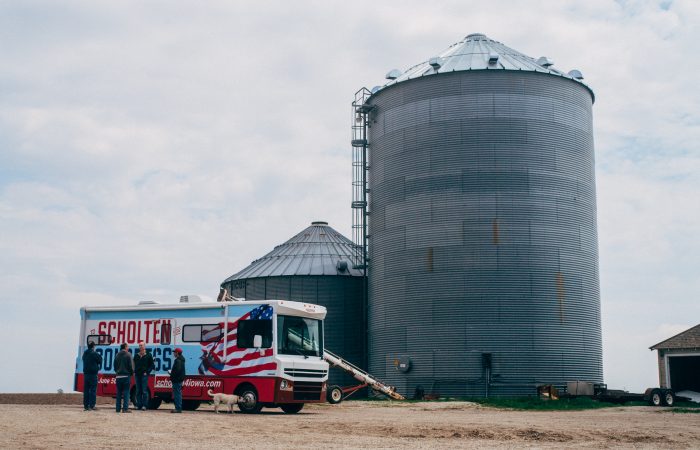
Scholten spent much his first campaign visiting all of Iowa’s 39 counties.

Country of origin labeling—that’s where we’re seeing a lot of movement, and King actually has been on the on the floor talking against it. But if I want to have a steak and I see something that says Iowa Beef, I want it to be from Iowa.

What’s your response to what’s happening as coronavirus has spread in meatpacking plants in Iowa and across the middle of the country? 

The warning sign in all of this happened last year with the [meatpacking] fire in Kansas. When that processing plant went down, it disrupted the whole market. It’s so concentrated. When we have 50 plants producing 98 percent of our beef in America, if one of those plants shuts down, we don’t have the flexibility or the adaptability to change the food system. And so that’s what we’re seeing in a lot of this. When my grandparents farmed back in the late ‘60s and early ‘70s, there were over 9,000 slaughterhouses [in the U.S.] and now there’s about 1,000.

And I understand some of them aren’t going to make it, and technology grows and you shrink. But to this level? I mean, [meat production] is more concentrated now than when Upton Sinclair wrote The Jungle, and we had this same battle a hundred years ago.

And people are getting sick and yet they’ve been asked to return to work. 

Right. And you see the power of the [meat] industry when the president didn’t have the executive order for PPE, but he made an executive order to keep our meat packing plants open. That’s an amazing amount of power.

In order for us to continue with these plants, we absolutely have to have that protection. We have to have continued testing. We have to have paid sick leave. What’s happening right now is so inhumane. We have a case in Denison, Iowa, about an hour and a half away from here. It’s been a meatpacking town for a long, long time; they have two plants there. And the mayor requested an expansion of testing and targeted testing and she was denied by the Governor. And this is a county that has over 100 people who have tested positive and is considered open. It’s nuts!

For the last decade there’s been a disconnect between what many consumers want—more localized food production, more supports for young producers and alternative production models—and what the House Agriculture Committee funds in the farm bill. And most of the current ag committee members are in very close contact with the folks at the top of the industry. If you’re elected, what would it take for someone like you to actually achieve any power on that committee? 

Since the last cycle, because of who I get to run against and the controversial aspect of that, I have a larger voice than the regular candidate running for Congress. I also have a louder voice because of the Iowa caucuses. I was able to work on five or six of the [Democratic] presidential candidates’ rural policies last year and those have been some of the most progressive platforms we’ve seen in the food discussion for a long time.

For decades, presidential candidates would come to Iowa and talk about ethanol. That’s it. This time, we heard them talk about climate change and how our food system is tied into that. And I’d like to think I had a little bit to do with that. But this is where we need more of what I like to refer to as “Dirt Road Democrats.” I’m trying to connect with farmers, but also folks who see the end of the process as consumers. They may not see where we’re coming from here. And I’m trying to connect the dots a little bit.

I talked to Jane Kleeb [Head of the Democratic Party in Nebraska] recently and that seems to be her project as well. There do seem to be a number of rural folks who have felt alienated by both parties. 

We got 25,000 more votes than there are Democrats in this district in the last cycle—and it was a midterm, which tends to be more conservative. So, I think there is this huge potential, especially in the Democratic party. It’s what I like to call the Dollar General Coalition. I mean, you have these rural areas that are just being decimated, but you have these inner-city areas that also have food deserts. And if we could connect the two using regional food hubs, we could have food assistance programs with quality food made locally—and that’s a game-changer for some of these communities.
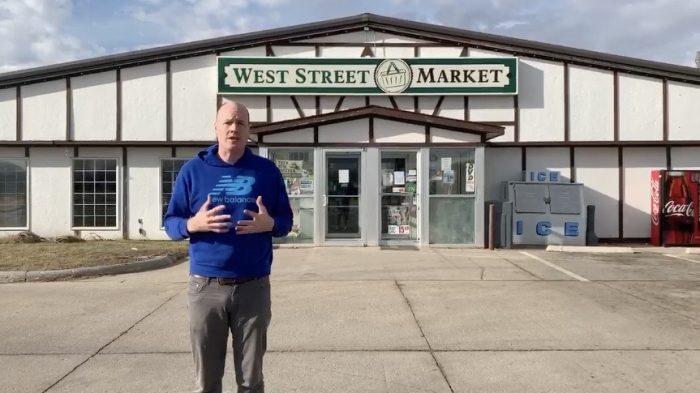
J.D. Scholten at West Street Market in Manning, Iowa. The local grocery store closed last year and the town rallied together to help it re-open.

But you would need a lot more people in rural areas to actually be growing food instead of corn and soy for animal feed, right? 

Yes, but it’s all policy driven. And with the COVID-19 crisis, there’s opportunity. When we come out of this, I think there will be a nation looking for change. You also have farmers here in Iowa who’ve had six consecutive years of low commodity prices.

Which is also a big motivator to change.

Farmers are some of the most resilient people. They’re my ancestors; they’re stubborn as can be. But when you present them with a challenge, they’re up for it. I mean look at [the sudden advent of the ethanol industry]—and how people adapted to that. If we challenged them to create and invest in these alternatives, the potential is huge.

I see what we’re doing as a nation, and there’s no long-term vision. We’re moving more urban. In this district people are moving to Des Moines, Omaha, and Minneapolis. But at some point we’re going to hit our limit there and we’re going have to have quality rural areas. How do we get there? We go back to the basics of what created these regional rural areas to begin with.

Diverse family farms.

Exactly. Agriculture.

I was in Minnesota this winter and organizers there have been very focused on finding ways to respond to the farm crisis ther. Are you seeing a farm crisis in Iowa, and if so, how is it being talked about?

It’s not being talked about that way, but it 100 percent is [a crisis]. It’s different than what it was in the ‘80s. It’s more of a slow torture. I mean, we’ve seen bankruptcies are up 20 percent to an all-time high and the farm debt is the highest in the nation. I have a friend who has a Century Farm and the dad just retired and the son was about ready to take over. The dad told him, “There’s no money in this; you’re going to work in town.” And so he works at a John Deere dealership. The kid wants to farm! And you hear stories like that all throughout the district.

You mentioned the recent presidential candidates’ surprising focus on soil health and regenerative agriculture. There are several outspoken voices pushing for more attention to regenerative practices in Iowa at the moment, including farmer Matt Russell of Coyote Run Farm. Do you want to say anything about those efforts? 

I went to the debate in Iowa and Matt Russell was sitting two rows ahead of the former secretary of agriculture, Tom Vilsack. And it was just such a visually impactful changing of the guard, and a [symbol] of the way the caucus was talked about when it came to agriculture.

Practical Farmers of Iowa, [a group that works to help farmers plant cover crops and more diverse rotations] was considered a radical group like a decade ago. And now, I mean, they’re one of the fastest-growing agriculture groups out there, and we’re seeing more folks out there doing similar work.

And again, it’s all policy driven. If we incentivize it, farmers are going to adapt to it. And so I’m hopeful that we can move in the right direction on this. But it also goes back to antitrust. I feel like the powers that be aren’t allowing for things to change or incentivizing [regenerative practices]. It’s not because people don’t want it, it’s because there are powers working against it. And that’s where we need to enforce our antitrust laws and make it a level playing field.

Is there anything else you want Civil Eats readers to know about the changes you’re hoping to make?

Our campaign gets a lot of attention because we’re opposing Steve King, but it’s so much more. This is going to transform the way we eat, and hopefully the way our children will eat. We had this battle one hundred years ago and we’re right back where we started. For climate reasons, for health reasons, there’s so much opportunity coming out of COVID-19 to change and improve the food system and make sure that we remain a secure nation because we can feed ourselves.

Written by Twilight Greenaway

The Economist: Steve King, Iowa’s most noxious politician, looks vulnerable

Giving offence is Steve King’s stock-in-trade. The congressman for Iowa’s fourth district has suggested heaven is off-limits to gay people, spoken up for white supremacy and posed with Marine Le Pen, Geert Wilders and other far-right populists. He has likened immigrants to animals. Many are smugglers, he once said, adding that migrant men have “calves the size of cantaloupes” from lugging bales of drugs. A decade before Donald Trump proposed walling up the border, Mr King was America’s leading xenophobe. He even posed in Congress with a model of a concrete barrier topped with electrified wires. Zap foreigners, he said, to keep ’em out.

Rural Iowans have swooned at that, and at how he has enraged urban, liberal folk. His admirers say that in person he is charm itself. After nine election victories, usually by huge margins, he has seemed entirely secure. In some counties he takes over 70% of the votes, thanks to a base of conservative Christians—Dutch Reform, evangelical, Catholic and Lutheran. They like his opposition to abortion, even in cases of incest or rape. He has also picked up protest votes. As family farms have died and home towns have dwindled, Mr King’s rage at the modern world seemed fitting.

And yet, after 17 years, he looks vulnerable. Republican leaders no longer coddle Mr King. Corporate donors are rejecting him. He has a paltry $43,000 on hand for re-election and faces a tough primary election on June 2nd. One poll suggests that Randy Feenstra, an equally conservative state politician with $416,000 in the bank, is just behind him in a field of five. The party (and Dutch Reform voters) back Mr Feenstra. This week the us Chamber of Commerce endorsed Mr Feenstra, as have other Iowan bigwigs.

On the face of it Mr King’s troubles date to January 2019, when he wondered aloud why “white supremacy” was an offensive term. Party leaders booted him off the congressional committees he sat on, which include agriculture (a perch that matters a lot to Iowans). Mr Feenstra says that marked Mr King as a failure. In fact, Mr King’s views on white supremacy are hardly new. His feeble showing three months earlier in the 2018 election was, however. “He is no longer a safe bet,” says Rachel Paine Caufield of Drake University, because he only scraped a narrow victory over J.D. Scholten, a first-time Democratic opponent.

Mr Scholten is a personable, lanky ex-professional baseball pitcher, who counts as a celebrity in Iowa’s fourth congressional district. A Republican strategist says there is a risk that the Democrat would win in a rematch; worse, she says, if Mr King lingers then voters in November may shun other Republicans, notably Joni Ernst, a senator in a tight re-election race. Mr Scholten reckons that plenty of Trump supporters back him. He also notes that last time he got 25,000 more votes than there were registered Democrats. That put him within 3% of winning. He also raised $2.3m, a mighty sum for a first-timer who supposedly had no chance. This time the money is gushing even faster.

The reason for this, he argues, is not just voter fatigue with Mr King, but mounting anger about the economic troubles that were evident long before coronavirus hit. Mr Trump’s trade war with China has suppressed prices for soyabeans and other agricultural commodities. Bail-outs have largely been grabbed by the biggest farmers. The ethanol industry is in the dumps. Workers in the meat industry and livestock farmers have been walloped by coronavirus. Mr Scholten thinks voters are warming to his call for antitrust measures to break the grip of a few giant firms over agriculture in the state.

Is Mr King doomed? No one knows how virtual campaigning and the use of postal ballots in the primary (and maybe in November) may skew things. He may do better in a presidential year than he did in the mid-terms. The incumbent likes a fight, and says “never-Trumpers” backed by “coastal elites” are conspiring to stop him. He could yet win the primary. Mr Scholten is eager that he does, to get that re-run from two years ago. After all, in baseball a team gets nine innings; Mr King has had his.

The Hill TV: Iowa congressional candidate: ‘Travesty’ that meatpacking workers haven’t had protective equipment

J.D. Scholten, a Democratic congressional candidate in Iowa, called it a “travesty” Monday that meatpacking workers in the state haven’t had access to proper personal protective equipment (PPE) during the coronavirus pandemic.

Scholten told Hill.TV that meatpacking plants’ setup allows for them to become hotbeds for the virus as employees “work in very close proximities.”

The Iowan cited a piece written by journalist Art Cullen who called the meatpacking workers “patriots” amid the U.S. outbreak.

“They were going in when everyone else was able to stay home,” Scholten said. 

“What we saw was they didn’t have the PPEs. They didn’t have the protection they needed, and it’s just a travesty,” he added.  

Scholten is running to take Rep. Steve King’s (R) seat in Iowa’s fourth congressional district.

The Centers for Disease Control and Prevention released data on Friday finding that more than 4,900 meat processing workers had tested positive for coronavirus.

Unsanitized: J.D. Scholten on How to Revitalize Our Broken Food Systems

On Wednesday, Donald Trump signed an executive order that the press reported as intended to force open meatpacking plants using the Defense Production Act. It doesn’t actually force open meatpacking plants. It delegates to the Secretary of Agriculture and basically tells him to do something about it. It was more of a typical PR ploy from Trump, to show his base he was working tirelessly to protect their precious hamburgers.

But there was one part of the order worth highlighting. In the policy section, the order notes: “closure of a single large beef processing facility can result in the loss of over 10 million individual servings of beef in a single day.” You may reasonably ask why we’ve created a situation where one processing plant closure due to an infectious disease can take that much food out of the system. Maybe that was the problem all along.

J.D. Scholten thinks so. He was the populist Democratic candidate who almost defeated Steve King in the deep-red 4th Congressional District in Iowa in 2018. He’s running in a possible rematch with King this year, and his home in Sioux City is situated in the U.S. county with the most rapid increase of COVID-19 cases in America. Why? “Sioux City has been an immigrant meatpacking town since the 1880s,” Scholten told me in an interview. “When my family moved her in 1984, our first family photo, which was our Christmas card that year, was in front of the stockyard plant.”

Meat processing plants are hotspots for the outbreak because of a reluctance on the part of plant managers to keep workers safe; one lawsuit indicates that workers were not given time to wash their hands or wipe their noses. Scholten visited a Tyson plant in Dakota City, Nebraska on Tuesday, where managers were testing every employee, but still telling them to work, with the test results not due back for three days. Late on Wednesday, Tyson finally closed the plant for four days.

The backlog of meat processing squeezes farmers and ranchers, who have to either continue to feed their stock, sell them to someone who can, or undergo mass kills. But Scholten points out that the pandemic only increased their existing hardship. “Just last week, packed beef was going for $100 more than live cattle,” he said. “Meat is going off the shelf at higher prices but the farmers aren’t getting a higher price. I know there’s talk about farmers and workers, but it’s both against the packers right now.”

Meatpacking is a deeply concentrated industry. Four Big Ag monopolies control 85 percent of the nation’s beef, and 50 plants produce 98 percent of the supply. Where there were once 10,000 slaughterhouses, there are now about one-tenth. This forces ranchers to accept low prices if they want their cattle to get to market. It also hollows out communities by consolidating the skilled processing labor instead of spreading it out county by county. “That’s a lot of rural development jobs,” Scholten said. “It’s led to rural poverty and a decline in the rural economy.”

Two of those big beef companies are Brazilian conglomerates. One in four hogs in the U.S. is owned by a Chinese-owned firm like Smithfield Foods. And a lot of this product doesn’t end up on American tables. “Sixty percent of apple juice is made in China,” Scholten noted. “Here in our district there are apple orchards all over the place, and we’re not an apple area. All these policies, geared toward international trade, we’re losing sight of our base of agriculture and our food system. Who are we doing this for?”

Scholten explains that 85 percent of all food in Iowa is imported, which is crazy if you drive around the state and see endless crops. There are only two “farm to table” restaurants in his entire district, a district made up of essentially all farms. Even local groceries have been overrun by Dollar General, which doesn’t sell fresh meat and produce. Decades of prioritizing outsourcing and enabling market dominance has destroyed the local and regional culture of our food system, and ruined self-sufficiency, just like supply chains for medical equipment or defense products or almost everything else.

In the short term, Scholten wants to see short-term coordination, to end the absurdity of millions struggling to find food in understocked food banks while farmers bulldoze crops and throw away milk. He wants significant protections for food system workers, too, so they don’t have to choose between risking their life and losing a paycheck. But in the long term, Scholten proposes serious antitrust enforcement to break up Ag monopolies (modernizing the antimonopoly Packers and Stockyards Act, which turns 100 next year, tops the list), and returning to a sustainable local supply system. “We need to implement farm to nursing home, farm to prison, farm to community schools,” he said. “Ag is almost all policy driven. We can create that market and let it grow. And allow more money to stay in the communities that grow the stuff.”

Written by David Dayen

Iowa Starting Line: JD Scholten: Food Supply Chain Doesn’t Have to Be So Fragile

When it comes to the problem of outbreaks at meatpacking facilities and whether to temporarily shut them down, the workers at the plants and the farmers selling their livestock to plants are often pitted against each other.

JD Scholten, who’s running for Rep. Steve King’s seat in Iowa’s Fourth District, rejects that premise.

“It’s kind of a double-whammy,” he said. “I 100 percent disagree that it’s farmers or workers; it’s both. They’re both getting screwed at this point.”

And it’s largely because only a few companies control the nation’s meatpacking operations, making workers more necessary and giving farmers few options. These operations are where the majority of coronavirus outbreaks in the Midwest are occurring.

In Iowa, that has led to local officials calling for Gov. Kim Reynolds or the companies themselves to temporarily shut down production so communities can do testing and cleaning to contain the outbreaks.

But the biggest counter-argument for closing these meatpacking plants is that closures and reduced production will affect the nation’s food supply, which Iowa plays an outsized role in.

It doesn’t have to be like that.

The solution is to enforce antitrust laws, Scholten said, so there are more meatpacking and slaughter operations. Then, hard-hit plants could close for cleaning and employee testing without the food supply feeling it.

“If a plant goes down, it affects everything,” Scholten said of the current arrangement, where plants like the Smithfield one in South Dakota process about five percent of the nation’s pork. “So, there’s not much resiliency or sustainability or adaptability.”

Expanding the market will also open up options for where farmers can sell their livestock, which has been a challenge for the past few weeks. Recent reports have talked to many farmers who faced the prospect of euthanizing their animals if they couldn’t sell them to plants.

“When we come out of this, we absolutely have to enforce our anti-trust laws, and the biggest thing that that will do is allow farmers to have competitive markets,” Scholten said. “So, [farmers] can continue to sell to Tyson and JBS and all these different entities, but now what I’m saying is there’s also a potential to sell to a local person and create alternative markets.”

It would put less pressure on workers, too, who have continued going to work despite the health risks.

“It’s insane that these workers have been going without PPE and without masks,” Scholten said. “No one should have to choose between earning a paycheck and their life.”

Yesterday, Donald Trump used the Defense Production Act to sign an executive order requiring meatpacking plants to remain open as part of the nation’s critical infrastructure.

According to Bloomberg News, part of the order the government will provide protective equipment and guidance, but Trump gave no details. However, there are signs that companies won’t be held liable for employee or customer infections and deaths.

In Sioux City, an outbreak at a Tyson Fresh Meats facility in Dakota City, Nebraska is widely suspected to be the main reason for the metro area’s explosion of cases.

Tyson’s refusal to confirm or deny the numbers led area mayors on Monday to issue a call for transparency on where the cases are coming from. In Woodbury County, the number of cases have increased by 674 in nine days.

“It affects all of us. These workers go to the same grocery store I go to. They’re my neighbors. And it’s one of those things where we’re all in this together,” Scholten said. “And if [companies] are going to be part of our community and ask so much from our community, this is the least they could do for us.”

Meat packing companies in Iowa like Tyson have repeatedly assured officials they’re following social distancing guidelines and providing PPE to the people working on the floor, but accounts from workers there contradict those promises.

Still, the area governors—Reynolds, Nebraska Gov. Pete Ricketts and South Dakota Gov. Kristi Noem—have refused to issue stay-at-home orders or order the plants to close.

Previously, Ricketts rejected the idea of closing any Nebraska plants, suggesting that a meat shortage would result in demonstrations like those seen in other states. Noem and Reynolds have left the final decision up to the plants

“It’s about having a food system that is more local and regional. These are all very doable things, it’s just what we’re seeing right now is putting a spotlight on this,” Scholten said. “I hope on the back end of this we really come out of this with the idea that our food system is extremely valuable to our nation and our nation’s security and we need to be more resilient and flexible.”

Written by Nikoel Hytrek

The Intercept: SMALL FARMS, ALREADY STRESSED AND UNDERFUNDED, STRUGGLE FOR FEDERAL CORONAVIRUS RELIEF

BEFORE CORONAVIRUS HIT, farmers in the U.S. were already hurting from years of falling food prices, severe weather, and, more recently, President Donald Trump’s trade war. “We’ve had a record number of farm bankruptcies [in the U.S.], total farm debt is at $425 billion, [and farmer] incomes have fallen by about half since 2013,” said Eric Deeble, policy director at the National Sustainable Agriculture Coalition, which supports small and mid-sized family farms.

Now, with the global pandemic closing factories and restaurants and disrupting supply chains, already stressed farms are grappling with lower demand and fewer markets to sell in, as well as a presidential administration that favors relief for big businesses over small. Small farmers in particular — those who sell directly to farmers markets, schools, and other local food hubs — are facing an existential crisis, as they face slim odds of accessing competitive federal stimulus money.Join Our NewsletterOriginal reporting. Fearless journalism. Delivered to you.I’m in

They have reason to be pessimistic. In recent years, federal subsidies to help struggling farmers have flowed almost exclusively to large corporate farms. Of the roughly $28 billion the Trump administration has distributed to food producers to offset losses from his trade wars, almost all went to big farms.

Advocates for small farmers say this is driven in part by the preference of Trump’s agriculture secretary, Sonny Purdue, who has encouraged farmers to get bigger farms if they wanted to stay in business. “Big get bigger and small go out … and that’s what we’ve seen,” he told a group of Wisconsin dairy farmers in 2018, echoing Richard Nixon’s agriculture secretary, who infamously told farmers in the 1970s to “get big or get out.” While 91 percent of U.S. farms are small — defined by the federal government as an operation with gross cash income under $250,000 — large farms account for 85 percent of the country’s farm production.

The public health crisis has already had a devastating impact on agriculture across the country. A report released in mid-March by the National Sustainable Agriculture Coalition estimated that small farms would see a $689 million decline in sales from March to May this year due to Covid-19, leading to a payroll decline of $103 million and a total loss to the economy of $1.3 billion. Now, as the pandemic shows no sign of slowing, the coalition worries that the impact for small farmers will be even more substantial — which could lead many small farms to permanently close.

Under pressure from groups like the National Sustainable Agriculture Coalition and the National Farmers Union, Congress did work to address some of the needs of small and direct-market farmers in the $2 trillion Coronavirus Aid, Relief, and Economic Security, or CARES, Act, signed into law on March 27. While lawmakers did not include all that advocates pressed for — like emergency food purchases from small processors and direct payments to small farms — the CARES Act did allocate $9.5 billion to farmers and said some (unspecified portion) of that amount should go to “producers that supply local food systems, including farmers markets, restaurants, and schools.”

But in the weeks following the CARES Act, farmers struggled to access any relief, as the agriculture aid stalled and many farmers found themselves ineligible for the Small Business Administration emergency loans. On April 10, 33 senators sent a bipartisan letter to Purdue, urging the USDA to follow the CARES Act and distribute federal aid to small farmers specifically. A week later, when the USDA finally announced how it planned to allocate the $9.5 billion from the CARES Act, it appeared that no money would be reserved specifically for small farmers.

In a statement provided to The Intercept, a USDA spokesperson said the department planned to provide assistance to “most farms” that experienced at least a 5 percent loss. To ensure that funding will help small farms, the USDA said it “is utilizing payment limits and [adjusted gross income] eligibility criteria that were used by Congress when developing the 2018 Farm Bill” — the same bill that left small farmers in the lurch over the last two years. The spokesperson also said that the USDA planned to use a $900,000 AGI limit for those who do not make 75 percent or more of their income from farming — a notably high threshold considering that small farmers earn between $1,000 and $250,000 from their farms.

“Bailout money always goes to the big farmers, the people who produce soy and crops and sell into commodity markets,” said John Peck, executive director of Family Farm Defenders, a national organization that supports sustainable agriculture. “This is all part of our country’s cheap food policy where we basically subsidize capital-intensive, large-scale industrial farming.”

Farmers who sell directly to consumers or participate in regional food hubs typically don’t rely on federal subsidies.

“Small diversified farmers are pretty effective at doing what they do, which is finding markets and filling them, and haven’t required a lot of support,” said Deeble. “But the flip side is if you’re usually good in normal times and don’t rely much on the government, it can be harder to get government help when you need it.”RelatedThe Food Supply Chain Is Not Yet in Danger — but the Workers Who Keep Us Fed Are

J.D. Scholten, a Democratic House candidate running in Iowa’s 4th Congressional District, said there’s still a lot of uncertainty about how the federal stimulus money will be allocated, “but what we’ve seen [since the trade wars] is that Secretary Purdue gets to dictate who gets bailed out and who doesn’t, and there’s not a lot of oversight.”

Colby Ferguson, a small farmer and the director of government and public relations for the Maryland Farm Bureau, defended the bulk of federal subsidies flowing to large farms. “They should get most of the money since they generate the most volume of our food supply,” he said. “If we didn’t help the big guys, that would also affect the small guys.”

The Farmers Market Coalition, a nonprofit that supports local markets across the country, has also been pushing for emergency aid and a federal declaration that farmers markets should be allowed to operate as essential businesses. (California has deemed farmers markets essential, but other states have shut them down or left it more ambiguous.) Advocates say open-air markets can serve as a safer way to buy groceries during the pandemic.

“If farmers markets go out of business that means local farmers lose access to those consumers,” said Ben Feldman, executive director for the Farmers Market Coalition. While American food purchasing has swiftly shifted during the pandemic from restaurants to grocery stores, it is typically much harder for small farmers to sell their products to large grocery stores.

“I don’t want to be alarmist, because farmers market operators, like the farmers who sell to them, are very resilient and adaptable and do an incredible amount with very limited resources,” said Feldman. “But this could definitely force markets to close.”

According to the USDA, local food sales more than doubled between 2012 and 2017. But profit margins for small farmers remain low or nonexistent, and most small farmers also have other jobs.

Peck of Family Farm Defenders said he worries this pandemic will be exploited by big corporations to crush the local food movement and correspondingly wreak further damage on the climate. “To feed the world and cool the planet, we need to move away from industrial agribusiness,” he said.Share Your Coronavirus StoryClick here to learn about contacting a reporter securely, or email us at [email protected]

Some advocates say they’re cautiously optimistic that the next stimulus bill could offer more help to small farmers and noted that there’s been growing public awareness of the risks posed by our global supply chain and the need to invest in a more resilient food system.

Scholten, who has been sounding the alarm for years about the risks of monopolized agriculture, said the pandemic exposes how “dangerously dependent” we are on imports. “We’ve had these ‘get big or get off the farm’ policies for years,” he said. “But I think there’s huge potential now to regionalize our food production, localize it.”

“In the 4th District of Iowa, the second-most agricultural producing district in the nation, we have only two farm-to-table restaurants; we have small towns losing their grocery stores because Dollar General is coming in and undercutting them, but they don’t sell fresh produce and meats, and we have farmers not making a dime,” he said. “So who are we doing this [production] all for?”

By Rachel Cohen

Mother Jones: Is This the Year Democrats Finally Take Down Steve King?

On a Sunday evening in mid-November, J.D. Scholten stood in the Swaledale, Iowa, City Hall and spoke, as he often does, about sandwiches. Scholten, a Democratic candidate for Congress in the state’s once reliably red 4th Congressional District, was in the midst of a series of town halls he called the “Don’t Forget About Us” tour, often making several stops a day in communities with fewer than 1,000 residents. About three dozen people were packed into the building’s only room, a wood-paneled space with paintings along the wall and a sagging ceiling that the 6-foot-6 Scholten could almost scrape with his perfectly bald head. Swaledale (population 158) was the smallest town he went through that day, and like most places he’d visited, it no longer had a grocery store.

“If you go from Sioux City and take the next three towns east on Highway 20,” he said, sketching a picture of the district for the crowd, “three of those have lost their grocery store in the last five years, and two of them have gained Dollar Generals.” Heads began to nod. “If you want a BLT in Correctionville, Iowa,” he continued, “you either have to grow your own tomato or drive into Sioux City to get one.”

At three stops over five hours, Scholten returned to the same themes—the rise of Dollar General, the exodus of young people, the pork monopolies, the GoFundMes for cancer patients, the grain elevators that couldn’t stay open without immigrant workers. But there was one subject Scholten almost never brought up: Steve King, the nine-term white nationalist Repub­lican incumbent he’s trying to unseat.

“We never do,” Scholten told me, expressing surprise at my surprise. “Not never—we rarely talk about Trump, rarely talk about King. We talk about what we’re for.” Besides, he added, “we don’t know if it’s gonna be King at this point.”

And that’s the catch. When Scholten ran his first campaign against King two years ago, he was the longest of long shots, and a bit of a curiosity—a former minor league baseball player driving around in an RV called Sioux City Sue, camping in Walmart parking lots, and trying to take down a longtime incumbent in a district President Donald Trump carried by 27 points. But Scholten, boosted by a prolific grassroots fundraising operation and a kind of populist agrarianism that had largely disappeared from his party, closed the gap. On Election Day 2018, he lost by just three points—one of the biggest swings of any district in America.

A lot has changed since then. King has become a pariah in Washington and in his own party. In January, House Republican leadership stripped him of his committee assignments after he defended white nationalism in a New York Times interview. He has been left to voice his frustrations with the political system in unhinged social media screeds. Many of his biggest corporate donors are moving on, and primary challengers are lining up. The 2020 election might be Democrats’ best shot at taking King down—unless Republicans get him first.

There’s no small irony in King’s demise: His career is sliding off the rails just as the noxious ideas that he’d devoted that career to advancing have finally reached the highest levels of power. 

In 2012, I sat with a small group of reporters in a cramped room in a DC hotel for a panel called “The Failure of Multiculturalism.” The event, part of the annual Conservative Political Action Conference, had caused a stir because of the presence of several attendees described as white nationalists. An hour into the talk, in walked Steve King. He took a seat near Peter Brimelow, founder of VDare, an anti-immigration website named after the first English child born in North America. (Brimelow is currently suing the New York Times for labeling him a white nationalist.) “I’ve read your books!” King told Brimelow admiringly. Afterward, King shrugged off the exchange and told reporters he was only there to promote legislation. This wasn’t about racism; it was about making English the national language. Two very different things, you see.

For a decade and a half, this was the game that national Republicans let King play. Maybe he was a little odd, perhaps he was a little coarse, but he was odd and coarse within the contours the party deemed acceptable—he was just a regular guy who wanted to build a fence along the border and electrify it so that migrants (“with calves the size of cantaloupes,” he once said) would stay out. And the party had ample space for people like that. He co-chaired Ted Cruz’s presidential campaign, then became one of Trump’s biggest boosters.

All the while, his white supremacism was in plain sight. In 2016, King conducted a local news interview with a Confederate flag on his desk, wondered aloud if anyone had contributed more to civilization than white people, and tweeted that “cultural suicide by demographic transformation must end.” In 2017, he said that “somebody else’s babies”—code for nonwhite immigrants—threatened to overtake the American experiment.

Even as Scholten’s campaign gained traction in 2018, King kept on going. When he was asked what a “white nationalist” was, he expressed frustration that the label had become “a derogatory term today—I wouldn’t have thought so maybe a year or two or three ago.” He endorsed a neo-Nazi for mayor of Toronto. He called Mexicans “dirt,” then said he hadn’t, then barred the reporter who recorded him from an event. King drew a rebuke from the National Republican Congressional Committee, and some of his major agribusiness donors, like the meatpacking giant Smithfield Foods, jumped ship. Yet even after all that, the state’s three most powerful elected officials rallied to his defense. Sen. Joni Ernst and Gov. Kim Reynolds held a last-minute rally to shore up support for King, and Sen. Chuck Grassley filmed a short video endorsing King, declaring, “Iowa needs Steve King in Congress.”

Apparently, Iowa didn’t need King so much as it just needed King to beat Scholten. With that out of the way, the break finally came in January 2019, after a Times reporter asked King, once more, about white supremacy. “White nationalist, white supremacist, Western civilization—how did that language become offensive?” King said. “Why did I sit in classes teaching me about the merits of our history and our civilization?” In response, House Minority Leader Kevin McCarthy (R-Calif.) stripped King of his committee assignments, including his precious spots on the agriculture and judiciary committees. Several Republican colleagues suggested King should resign.

Randy Feenstra, a Republican state senator who had announced a primary challenge to King just a few days earlier, saw a window of opportunity. “Our current representative’s caustic nature has left us without a seat at the table,” he said, calling King’s comments “abhorrent.” King beat back primary opponents in the previous two cycles, but Feenstra is his most serious challenger by far. Feenstra now has the backing of Bob Vander Plaats, one of the state’s most influential conservative activists, and Bruce Rastetter, a multimillionaire ethanol magnate dubbed “the real Iowa kingmaker” by Politico.

But Feenstra had also been a supporter of King for years, long after King’s racism became undeniable. In fact, just a few days after entering the race, Feenstra confirmed on a conservative radio show that he’d once told King’s son and campaign manager, “I love your dad. I’d never run against him.”

As Scholten drove past fields of corn and soybeans on the road to a town hall in Marble Rock (population 291), he reflected on his newfound competition. “As far as I can tell, the only thing I see them running on is they can beat me but Steve King can’t,” he said.

After his 2018 loss, Scholten started a chapter of a national nonprofit focused on poverty and became a regional dignitary, ushering Democratic presidential candidates around the district and pressing them for specifics on farm policy, especially his desire to break up the big agricultural corporations. “I’ve worked on probably five or six of the rural policies of the presidential campaigns,” he says. “Part of the reason you see antitrust in a lot of the presidential stuff—even Biden has it—is because I was pushing from the very get-go.” He’s hosted a town hall with Cory Booker and shot hoops with Andrew Yang. They get a friendly introduction; Scholten gets an audience.

Perhaps anyone can beat Steve King this year. But actually maintaining control of a rural district like Iowa’s 4th requires a deeper policy recalibration. Scholten toes a cautious line on health care (“I’m for all of them,” he said of the Democratic candidates’ plans) but a robust one on climate change, with an ag-centric approach that he says will help farmers’ bottom lines by paying them to conserve land and pump carbon into the soil.

Trust-busting is the core of his economic message. “If you know a pork producer, ask them how they did in 2017,” he tells an audience of mostly seniors (and one Republican opposition researcher) at a library in Fredericksburg.“Smithfield…owns one in four hogs in Iowa and across this nation. The CEO of China Pork, who owns Smithfield, made $291 million in 2017. That’s more than Elon Musk. That’s more than the CEO of Apple. That’s crazy.” The agriculture industry is more consolidated today, he said, “than when Upton Sinclair wrote The Jungle.” Scholten might be the only candidate in America talking about the Packers and Stockyards Act of 1921.

When I asked voters at Scholten’s events how they felt about King, “embarrassment” was the most common response. Several brought up his loss of committee assignments. “It’s like having someone represent you that can’t do anything,” said Frank Rottinghaus, the Democratic Floyd County treasurer, as he waited to hear Scholten speak in Marble Rock.

But King isn’t going down quietly. With virtually no campaign cash but plenty of free time, he held town halls in his district’s 39 counties last year. Officially, he was updating constituents on what he was doing in Washington, but since he can’t really do anything in Washington, he devoted much of his time to clearing his name and trashing his rivals. At one stop, King read aloud from 1984. He tried to salvage his disastrous Times interview, claiming variously that the paper distorted his words and that the hearing-assistance device he plugs into his iPhone was not properly set up. On the House floor, he alleged he was the victim of a conspiracy led by the financier George Soros—the same man he held responsible for Trump’s impeachment.

In December, as the House moved toward impeaching the president, the Judiciary Committee was the hottest seat for members of Congress seeking to boost their national profiles. But one voice was missing: King’s. As his colleagues took their turns preening for national TV cameras, the man who paved the way for Trumpism, long before Trump launched his campaign, was reduced to recording a video of his thoughts for Facebook, a hunting cap hanging from the coatrack beside him.

“You’re live,” a staffer told him. For now, at least.

Written by Tim Murphy

The Washington Post: For Trump, hints of trouble in ethanol country

Democratic congressional candidate J.D. Scholten rumbled his RV to a stop in the gravel a mile east of Pomeroy, Iowa, (pop. 612) on Tuesday. A man got out of a car blocking the road ahead and flagged down the aging Winnebago that serves as Scholten’s headquarters and road unit.

John O’Brien of Fort Dodge marched up to Scholten’s window and stuck his mitt through for a shake. “Need a driver? I’m retired now. Just bagged two pheasants,” he explained.

Scholten, a 39-year-old former semi-pro pitcher, was out on a 14-county “Don’t Forget About Us Tour” targeting Iowa towns of 1,000 people or fewer in his uphill climb against Rep. Steve King, the anti-immigrant Republican who dabbles in white nationalism.

King’s hokum has earned him four GOP primary opponents next June. Last winter, House leadership stripped King of his committee assignments for the latest in a 20-year string of outrageous comments about Mexicans, gays and the superiority of white northern European cultures. King’s base here remains solid. Pro-life voters stand with him in this land of German Catholics, stoic Lutherans and Dutch Reform enclaves for whom abortion is the main, if not the only, issue. His public shaming serves King well as an embattled populist foil to the Washington elite who rig the game against us out here amid the swaying dry corn of northwest Iowa.

Scholten gave King, 70, a scare last year in an election that saw Democrats take the House. In Iowa’s 4th Congressional District, Republicans outnumber Democrats by 70,000. Scholten finished 10,000 votes short. “Last time I thought we could win,” Scholten said. “This time I expect we will win.”

While much of the state is in the throes of harvest, Scholten says he smells something in the corn dust. Farmers here are unhappy with President Trump for granting 31 petroleum refineries waivers from federal requirements that they blend corn ethanol into their gasoline. Corn prices dropped not long after. Former governor Terry Branstad, now ambassador to trade-conflicted China, warned Trump not to grant the waivers. Trump did it anyway. “They screwed us,” Republican Sen. Charles E. Grassley, the state’s senior senator, admitted. (Corn prices are still up about 20 cents a bushel from last fall, near the break-even point for most growers.)

Now, two of state’s 54 ethanol and biodiesel plants have shut down while others have reduced production or are on “hot idle,” and ethanol prices have dropped since the waivers took effect. Meanwhile, the trade war knocked the price of soybeans off by one-third; China was Iowa’s biggest agricultural export market. Trump-voting farmers who serve on ethanol cooperative boards swear they will not be hoodwinked again. That gives the Democrats a chance — if only a chance — to take back a House seat here in Iowa’s most conservative corner.

Keith Kuhrt was among 29 folks who turned up in Pomeroy willing to listen and volunteer. “I’m totally for J.D.,” said Kuhrt, who works at a Valero ethanol plant about a half hour away from here in Fort Dodge. “He’s not King.” A dozen more showed up at Early, Iowa, (pop. 523) later that night. Early is in King’s home county. It could scarcely be redder. Those are strong turnouts a year ahead of the election. They warmed to Scholten’s populist call for antitrust enforcement in agribusiness, universal health care and a fair shake for forgotten places. Their questions were about ethanol, rising health-care costs and rural development. Nothing about impeachment.

Scholten senses a wave. People are fed up with King, Trump and $12-an-hour jobs with a $5,000 deductible on the health plan, he says. Scholten thinks Elizabeth Warren and Pete Buttigieg will be duking it out to win the Iowa caucuses in February, “but it’s really still a wide-open field.” Buttigieg organizers attend each of his events, signaling that they intend to do battle along the rural routes. He invited all the presidential candidates on his tiny town tour, but only Cory Booker took him up on it.

“You win by getting out there and talking with people,” Scholten says. “I don’t bash Steve King at the convenience store. I talk about that tin cup on the counter to pay for somebody’s medical bills. We talk about how we are better than that.”

It seems to be working, when men with shotguns on gravel roads ask how they might help, and Dutch farmers swear they will not vote for Trump or his acolytes. There is unrest in the towns that Trump forgot.

Written by Art Cullen. Art Cullen is editor of the Storm Lake Times in Northwest Iowa. He is author of the book “Storm Lake: A Chronicle of Change, Resilience, and Hope from a Heartland Newspaper.”